Master Data Management (MDM): definition, challenges and the Afineo multi-domain solution
Master Data Management (MDM), or reference data management, has become a strategic pillar for any organization wanting to make its business data reliable, centralized and usable. In an environment where channels, tools and information flows keep multiplying, having a single, reliable, up-to-date domain is no longer a competitive advantage, it is an operational necessity.
Discover what MDM is, how it works, its concrete benefits, its use cases and what sets the Afineo multi-domain approach apart on the market.
What is Master Data Management (MDM)?
Master Data Management is a set of technologies, processes and rules that allow a company to define, centralize, qualify, maintain and syndicate its reference data.
This data, called Master Data or master records, covers all the information essential to the business: products, customers, suppliers, employees, distributors, stores, financial assets and more.
The role of MDM is to guarantee:
- the uniqueness of the data, with duplicates removed
- consistency, the same value everywhere in the company
- quality, with complete, approved, up-to-date data
- traceability, with a history of changes and audits
- controlled syndication to every system: ERP, PIM, DAM, CRM, e-commerce, partners and more
By centralizing this data in a single domain, MDM becomes the stable foundation that feeds the whole information system.
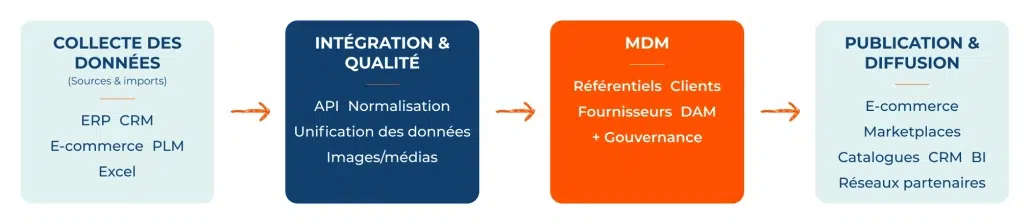
Afineo MDM architecture: data collection, integration, quality, domains and omnichannel syndication.
Why has MDM become essential?
The multiplication of tools, marketplaces, partners and distribution channels has made information management more complex than ever. Data silos pile up, errors spread, and teams lose time reconciling contradictory information.
MDM answers a central challenge: how do you guarantee data quality in a distributed, constantly evolving ecosystem?
- Consistency between systems and more reliable B2B and B2C exchanges
- Fewer human errors and lower associated operating costs
- Data structured so it can feed AI and business intelligence
- Regulatory compliance: GDPR, audits, legal obligations
- Faster go-to-market
- Reliable feeding of every digital channel
A robust MDM is a major accelerator of operational, digital and decision-making performance.
The 6 benefits of Master Data Management
Benefit 1 – Give your teams clean, qualified data
Every team works from the same data, approved upstream. No more multiple versions of the same product record, no more obsolete supplier contact details. The reference data is unique, reliable and available in real time.
Benefit 2 – Mobilize collective intelligence and gain agility
The collaborative governance of MDM makes each department accountable for the data it owns. Approval processes give value to everyone’s role and smooth collaboration between marketing, procurement, logistics, digital and IT teams.
Benefit 3 – Cross-reference your data to create more competitiveness
Multi-domain MDM lets you cross-reference data from different domains to build the most relevant offers, spot opportunities and anticipate risks. That is where the real business value of data is created.
Benefit 4 – Turn your data into usable information
Thanks to personalized dashboards and operational views, every team member gets the indicators useful to their mission. Raw data becomes concrete decision support that can be acted on immediately.

Benefit 5 – Avoid operational and compliance errors
MDM removes duplicates, detects inconsistencies and guarantees regulatory compliance. The risks of errors in production, in logistics or in B2B exchanges are drastically reduced.
Benefit 6 – Work from reliable reporting
With a single source of truth, your reports finally reflect the reality of your business. Sales analysis, supplier performance tracking, profitability by channel: every strategic decision rests on certified data.
Multi-domain MDM: the Afineo approach
What sets Afineo apart from other solutions on the market is its native multi-domain approach, and its ability to manage several data domains simultaneously in a single, interoperable platform.
What is a multi-domain MDM?
A multi-domain MDM lets you build as many domains as you need, according to your business requirements, and have them interact with each other:
- Product domain
- Supplier domain
- Customer domain
- Distributor and sales network domain
- Employee domain
- Store and outlet domain
- Subsidiary domain, for international operations
- Third-party domains: physical assets, financial data and more
Each domain is managed separately, with its own business rules and approval workflows. Teams access the data they need simultaneously, in a personalized and secure way.
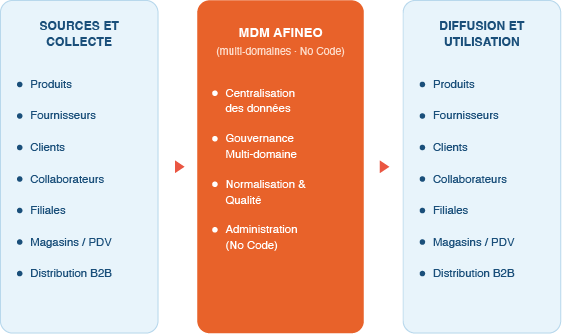
The Afineo MDM platform centralizes all your domains in a single, interoperable environment.
Cross-referencing data: where competitiveness is created
Cross-referencing data from different domains lets you take the best decisions and create opportunities you would not otherwise see. For example, a retail chain can assess rises and falls in sales by cross-referencing precise periods, revenue data, outlets, their floor area and their location, in order to anticipate profitability and reduce unsold stock.
The most frequent MDM use cases
Product domain:
MDM centralizes product records, technical data, marketing content and regulatory information. It guarantees reliable omnichannel syndication to the web, marketplaces, distributors and outlets. Working from reliable product records, personalized per channel, lets you stay relevant, build effective promotional offers and increase sales.
Supplier domain:
Managing a supplier base well is essential. MDM structures the supplier relationship: unique data, identification of active suppliers, approval process for new entrants, purchasing management and compliance with internal procedures.
B2C customer domain:
MDM unifies customer profiles scattered across multiple closed solutions. It makes segmentation reliable, improves the personalization of marketing actions and reduces contact errors. Built-in reporting lets you analyze customer data and refine your strategy continuously.
B2B distribution domain:
With a growing number of contacts and constant regulatory change, MDM automates data exchange with distribution partners. Responsiveness, traceability, scalability: data exchange becomes a source of profit.
Employee domain:
HR digitalization is every bit as strategic as commercial digitalization. An employee domain lets you manage skills, compensation, training, recruitment and regulatory compliance. MDM smooths internal communication and improves the management of human capital.
Other areas of application:
The areas of application for MDM are varied: physical or financial assets, location data, country-specific regulatory data, certification data and more. The challenge is always the same: mastering, processing and sharing data across the organization for fast, consistent decision-making.
MDM, PIM, DAM: what are the differences?
Many companies confuse these three solutions. Here is the essential distinction:
| Solution | Role | Scope |
|---|---|---|
| MDM | Central multi-domain foundation | Every domain: products, customers, suppliers, employees and more |
| PIM | Advanced product information management | Enrichment, descriptions, marketing content, multichannel syndication |
| DAM | Digital asset management | Images, videos, documents, media |
The PIM is a sub-domain of the MDM: it manages product information in a personalized way, put in context for each channel.
Afineo brings the three together, MDM plus PIM plus DAM, in a single platform. No third-party connector, no data lost between tools, one unified user experience.
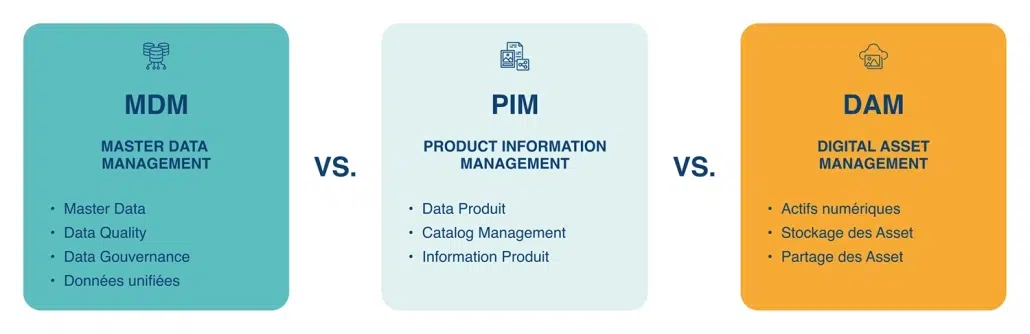
Afineo = MDM + PIM + DAM in a single platform.
How does MDM software work?
An MDM rests on several essential building blocks:
1. Data modeling and hierarchy
Defining the entities, attributes, classifications, taxonomies and business rules that structure the information.
2. Data integration
Centralizing data coming from ERP, CRM, marketing tools, e-commerce sites, supplier catalogs, Excel files or internal feeds, through APIs, imports and connectors.
3. Cleaning, deduplication and normalization
Identifying and correcting duplicates, inconsistencies, outliers and missing data.
4. Business rules and approval workflows
Every piece of data follows a structured cycle: collection, enrichment, control, approval, publication. These workflows ensure controlled, collaborative governance.
5. Syndication and synchronization
Once approved, the data is automatically distributed to ERP, PIM, DAM, CRM, e-commerce and partners through APIs or EDI. The MDM becomes the conductor of the company’s data.
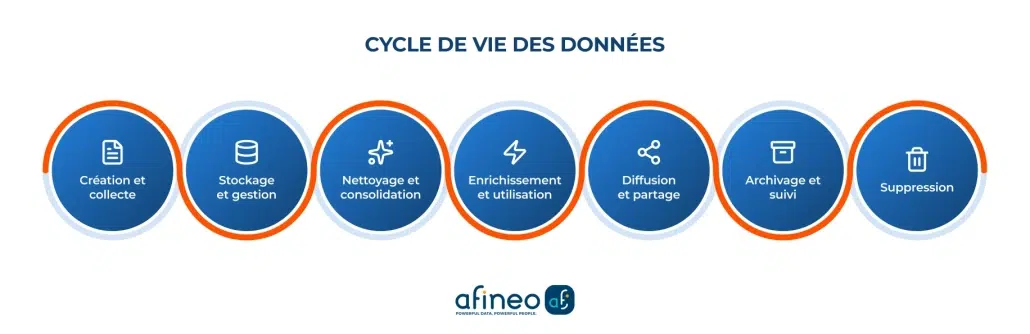
How do you choose your MDM software?
- Multi-domain coverage: does the solution handle all your domains, not just products?
- Modeling flexibility: can you create and modify your domains without development?
- No Code and Low Code: can your business teams take it on independently?
- Integration performance: native connectors with your ERP, CRM and e-commerce?
- Business workflows: are the approval processes configurable without IT?
- Ergonomics: is the tool easily adopted by business users?
- Speed of deployment: how long before the first ROI?
- Security and compliance: GDPR, encryption, rights management, auditability?
- Support: is the vendor based in France and available?
Our two MDM solutions
Multi-Domain MDM
Centralize and structure all your domains in a single platform: products, suppliers, customers, employees, outlets and more. Unified, reliable and scalable management for companies that want to unlock the full potential of their business data.
Group Multi-Entity MDM
Harmonize data across your brands, subsidiaries, countries or legal entities. Each subsidiary keeps control of its local specifics, from regulations to culture and language, while fitting into the global framework of the group. The ideal solution for complex organizations operating internationally.
Security, compliance and governance
- Data encrypted in transit and at rest
- Fine-grained management of roles, rights and permissions per user
- Complete history of changes and traceability of actions
- Native GDPR compliance
- Automated backups and data redundancy
- Certification and auditability
Why choose Afineo as your MDM solution?
- A complete multi-domain solution, the only one that covers all your domains in a single platform
- A 100% French SaaS platform hosted on Google Cloud
- No Code, your business teams are independent, with no reliance on IT
- Flexible, scalable modeling
- Configurable collaborative workflows
- Native omnichannel integration: ERP, e-commerce, B2B, marketplaces and more
- Automated syndication to all your systems
- Expert human support based in France
- Fast deployment and measurable ROI
A pioneer in data management since 2004, Afineo supports brands, manufacturers, distributors and retailers in their MDM strategy every day.
MDM FAQ: answers to the questions you are asking
What is MDM software?
MDM software centralizes, cleans, consolidates and syndicates the company’s reference data to guarantee its quality, consistency and uniqueness across every system.
What is the difference between MDM and PIM?
MDM manages every data domain: products, customers, suppliers, employees and more. The PIM focuses only on product data, its enrichment and its multichannel syndication. The PIM is a sub-domain of the MDM.
What is a multi-domain MDM for?
It lets you manage several data domains in one platform and have them interact with each other to create business value: more relevant offers, faster decisions, improved performance.
What are the concrete benefits of an MDM?
Data quality, fewer errors, regulatory compliance, faster decisions, better collaboration between teams, and the ability to feed AI and business intelligence.
Who is MDM for?
Multi-brand, multichannel and multi-system companies, and all those wanting to make their critical data reliable in order to gain competitiveness.
How long does it take to deploy an MDM?
With Afineo, the first domain can be operational within a few weeks, thanks to the No Code approach and the dedicated support of our French teams.
Ready to centralize your reference data?
Since 2004, Afineo has supported hundreds of companies in their MDM project. In 30 minutes, discover how our multi-domain platform can transform the way you manage your data.
 Afineo, a key player in reference data management, offers a SaaS MDM, PIM and DAM platform to support the digital transformation of businesses. Our multi-domain cloud solutions make data management and data quality easier, while ensuring smooth integration with your digital ecosystem.
