Pourquoi un PIM ? 7 bénéfices concrets pour votre entreprise
 Vous savez maintenant ce qu’est un PIM. La vraie question est : qu’est-ce que cela change concrètement pour vos équipes, vos ventes et votre croissance ?
De nombreuses entreprises gèrent encore leurs données produit à l’aide de fichiers Excel, d’e-mails et de documents dispersés. Ce fonctionnement peut suffire pendant un temps. Mais lorsque le nombre de références augmente, qu’un nouveau canal de vente s’ouvre ou que les données fournisseurs deviennent difficiles à fiabiliser, la gestion de l’information produit devient vite un frein.
Cette page présente les 7 principaux avantages d’un PIM pour les distributeurs, fabricants et e-commerçants : fiabilité des données, collaboration, time-to-market, performance commerciale, gestion du catalogue produit, efficacité des équipes et développement international.
Un logiciel PIM devient particulièrement utile dès que les volumes de produits, de contributeurs ou de canaux rendent les traitements manuels trop complexes.
Quels sont les principaux avantages d’un PIM ?
Un PIM centralise les informations produits dans un référentiel unique, structure leur enrichissement et automatise leur diffusion vers les différents canaux. Les bénéfices les plus fréquents sont :
- des données produit plus fiables sur tous les canaux ;
- moins d’erreurs et de ressaisies grâce à des workflows structurés ;
- un time-to-market plus court pour les nouveautés et opérations commerciales ;
- des fiches produits plus complètes, utiles à la conversion et au référencement ;
- une gestion du catalogue produit plus scalable lorsque le nombre de références augmente ;
- des équipes commerciales mieux équipées avec des supports toujours à jour ;
- un déploiement international plus rapide grâce à la gestion des contenus localisés.
Ordres de grandeur issus des résultats moyens constatés chez les clients Afineo. Le ROI réel dépend notamment du volume de références, du nombre de canaux et du niveau d’automatisation. Estimer votre ROI PIM.
Sans PIM : les 5 problèmes qui vous empêchent de grandir
Avant de détailler les bénéfices du PIM, voici les difficultés qui apparaissent le plus souvent lorsque la gestion des informations produits reste dispersée.
Des données produit disparates et contradictoires
Le fichier Excel du marketing n’est pas toujours identique à celui du e-commerce ou à celui transmis à l’imprimeur. Chaque service finit par travailler avec sa propre version de l’information.
Résultat : des fiches produits différentes selon les canaux, des descriptions incohérentes, des attributs manquants ou des mises à jour appliquées seulement à certains endroits.
Des fiches produits qui mettent plusieurs jours à sortir
Collecter les données techniques auprès du fournisseur, récupérer les visuels, rédiger la description marketing, adapter les contenus par marché, puis préparer chaque canal : sans référentiel central, chaque étape génère des allers-retours et des validations supplémentaires.
Plus le catalogue et le nombre de nouveautés augmentent, plus ce fonctionnement ralentit la mise sur le marché.
Des erreurs qui coûtent cher
Une dimension manquante, un visuel au mauvais coloris, un attribut technique erroné ou une information réglementaire obsolète peuvent entraîner des retours, des réclamations et du temps de correction.
Au-delà du coût opérationnel, ces incohérences détériorent aussi la confiance du client dans la qualité de l’information fournie.
Des équipes cloisonnées qui retravaillent les mêmes données
Le chef de produit saisit les informations techniques, le rédacteur web reformule les contenus, le graphiste adapte les visuels et le responsable marketplace prépare ses propres fichiers.
Sans processus commun, les mêmes informations sont souvent ressaisies ou contrôlées plusieurs fois. Les équipes passent alors davantage de temps à rechercher la bonne version qu’à enrichir l’offre.
Un time-to-market trop long face à la concurrence
Quand une nouvelle collection nécessite plusieurs semaines de préparation alors qu’un concurrent la met en ligne en quelques jours, la difficulté vient souvent moins des équipes que de l’organisation des données.
Un time-to-market court permet de lancer plus rapidement une nouveauté, une promotion ou un nouveau canal, et de saisir une opportunité commerciale au bon moment.
Avantage n°1 – une donnée produit fiable sur tous vos canaux
Le premier bénéfice d’un PIM est fondamental : disposer d’une source unique de vérité pour toutes les informations produits.
Chaque fiche est créée, enrichie et validée dans un référentiel central. Lorsqu’un attribut évolue — nouvelle photo, poids modifié, description corrigée, donnée réglementaire mise à jour — l’information peut ensuite être diffusée vers les différents canaux de vente : site e-commerce, marketplaces, catalogue imprimé, applications ou points de vente.
Les équipes ne dépendent plus de multiples fichiers envoyés par e-mail. Elles travaillent à partir d’une information commune, cohérente et traçable.
Pour une entreprise qui gère des dizaines de milliers de références sur plusieurs canaux, cette centralisation évite de multiplier les contrôles et les corrections canal par canal.
Avantage n°2 – une meilleure collaboration et moins d’erreurs
Un PIM structure la collaboration autour de la donnée produit. Chaque intervenant — fournisseur, chef de produit, marketing, qualité, traduction ou e-commerce — intervient au bon moment dans un processus défini.
Le fournisseur peut renseigner ses données techniques via un portail fournisseur. Le chef de produit les contrôle et les enrichit. Le marketing travaille les contenus. Les équipes qualité vérifient la conformité avant diffusion.
Chaque étape est tracée. Les validations sont visibles et les modifications restent identifiables.
Ce fonctionnement réduit les copier-coller, les doublons et les questions du type « qui a modifié cette fiche ? ». Les équipes consacrent davantage de temps à la qualité de l’offre et moins à la correction d’erreurs.
Avantage n°3 – un time-to-market jusqu’à 4 fois plus rapide
La réduction du time-to-market est l’un des bénéfices les plus visibles d’un PIM. Les données sont déjà structurées, les workflows de validation sont en place et la diffusion vers les canaux peut être automatisée.
Une opération commerciale qui nécessitait auparavant plusieurs semaines peut ainsi être préparée en quelques jours, selon l’organisation et la complexité du catalogue.
Chez des clients Afineo, certains projets ont permis de réduire fortement le délai de mise en marché de collections saisonnières ou d’opérations commerciales récurrentes.
Cette rapidité permet de capter une tendance au bon moment, d’exploiter une fenêtre de vente ou de répondre plus vite à une demande commerciale.
Avantage n°4 – des fiches produits plus complètes qui soutiennent les ventes
Une fiche produit riche, cohérente et structurée aide l’acheteur à prendre sa décision. Elle limite les zones d’incertitude et offre une expérience homogène quel que soit le canal consulté.
Le PIM permet de gérer dans une base produits structurée les descriptions courtes et longues, caractéristiques techniques, visuels HD, vidéos, documents, produits associés et autres attributs nécessaires à la vente.
Des fiches complètes peuvent agir sur trois indicateurs importants :
- Le taux de conversion : l’acheteur accède plus facilement aux informations utiles à sa décision.
- Le taux de retour : des caractéristiques exactes et des visuels cohérents réduisent les mauvaises surprises liées à l’information produit.
- Le référencement naturel : des contenus uniques, utiles et structurés donnent aux moteurs de recherche davantage d’éléments pour comprendre chaque produit et répondre aux recherches des internautes.
Avantage n°5 – une gestion du catalogue produit capable de changer d’échelle
Lorsque chaque nouvelle référence exige des ressaisies manuelles dans plusieurs outils, élargir un catalogue devient rapidement coûteux.
Avec un PIM, la gestion du catalogue produit est structurée : les données fournisseurs peuvent être importées, normalisées, contrôlées puis enrichies dans un même environnement. Les workflows permettent de répartir les validations et la diffusion évite de recommencer le travail pour chaque canal.
Un distributeur peut ainsi intégrer plus rapidement une nouvelle gamme fournisseur. Un e-commerçant peut tester une nouvelle catégorie sans faire croître dans les mêmes proportions la charge de travail liée aux données.
Avantage n°6 – des équipes commerciales mieux équipées
Le PIM ne bénéficie pas uniquement aux équipes digitales. Il améliore également le quotidien des commerciaux et des équipes terrain.
Générer un catalogue adapté à un rendez-vous client, sélectionner les produits pertinents, produire un PDF avec les visuels à jour ou mettre à disposition les derniers argumentaires devient beaucoup plus simple lorsque toutes les informations sont centralisées.
Les entreprises qui utilisent la norme FAB-DIS pour leurs échanges de données BTP peuvent également automatiser la génération de fichiers normalisés directement à partir du référentiel.
Le commercial dispose ainsi d’un support fiable, actualisé et adapté au contexte de vente, sans devoir reconstruire manuellement ses documents avant chaque rendez-vous.
Avantage n°7 – le PIM, un accélérateur du développement international
Déployer une offre sur un nouveau marché suppose de traduire les fiches produits, d’adapter les unités de mesure, de gérer les contenus locaux et de respecter les exigences réglementaires, notamment celles liées au Digital Product Passport (DPP) lorsqu’elles s’appliquent.
Sans PIM, chaque pays peut devenir un projet isolé. Avec un PIM international, la structure du catalogue reste commune tandis que les langues, attributs, contenus et règles de diffusion sont adaptés à chaque marché.
Un fabricant présent en France, en Allemagne et en Espagne peut ainsi gérer un même référentiel, organiser les traductions et suivre les adaptations locales sans dupliquer toute sa base produit.
Un ROI mesurable : les bénéfices du PIM dans la durée
Les bénéfices d’un PIM se mesurent sur des indicateurs opérationnels : temps passé à gérer les données, délai de lancement, qualité des fiches, nombre de canaux alimentés ou capacité à faire évoluer le catalogue.
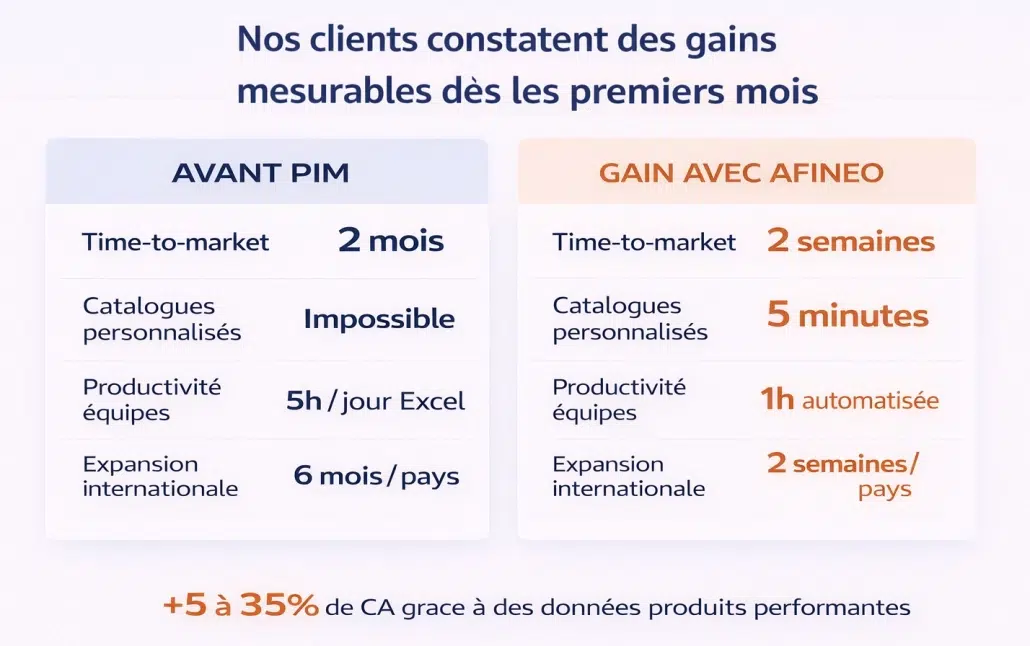
Jusqu’à 50 à 80 % de gain de productivité sur certaines tâches
Lorsque les équipes consacrent une part importante de leur temps à rechercher, vérifier ou ressaisir des informations produits, la centralisation et l’automatisation libèrent du temps pour l’enrichissement des contenus, l’analyse et le développement de nouveaux canaux.
Les gains varient selon le point de départ de l’entreprise, la qualité des données et le niveau d’automatisation déjà en place.
Des délais de mise sur le marché fortement réduits
Les lancements de collections, mises à jour saisonnières et opérations promotionnelles sont plus rapides lorsque les données sont structurées une seule fois et diffusées vers plusieurs canaux.
Les projets Afineo montrent que le time-to-market peut être réduit jusqu’à 75 % dans les organisations où une grande partie du processus était auparavant manuelle.
Un impact indirect sur le chiffre d’affaires
Le PIM ne génère pas du chiffre d’affaires « par magie ». Il crée toutefois des conditions favorables à la croissance : des fiches plus complètes, un catalogue plus large, davantage de canaux actifs et des lancements plus rapides.
Pour mesurer cet impact dans votre propre contexte, vous pouvez calculer votre ROI PIM à partir de vos volumes, de vos équipes et de vos canaux.
Les questions fréquemment posées :
Is a PIM suitable for small and mid-sized businesses?
Oui. Un PIM n’est pas réservé aux grands groupes. Il devient pertinent dès que la gestion des données produit mobilise plusieurs personnes, plusieurs sources ou plusieurs canaux et que les fichiers manuels commencent à ralentir les équipes.
Pour une PME, l’enjeu est souvent de faire davantage avec une équipe limitée : fiabiliser les informations, réduire les ressaisies et accompagner la croissance sans multiplier les tâches manuelles. Pour approfondir ce sujet, consultez notre guide : Quel logiciel PIM pour une PME ?
How long before you see the first effects?
Les premiers gains opérationnels apparaissent généralement dès que les principaux flux de données et workflows sont en production. Le délai dépend du volume de références, du nombre de sources à connecter et de la complexité des processus internes.
Pour le retour sur investissement global, les résultats constatés chez les clients Afineo se situent généralement dans une fourchette de quelques mois. Le calculateur ROI PIM permet d’obtenir une estimation adaptée à votre situation.
Do you already have an ERP?
L’ERP et le PIM ne couvrent pas les mêmes besoins. L’ERP gère principalement les flux transactionnels et opérationnels — commandes, stocks, achats ou facturation — tandis que le PIM organise les contenus et attributs nécessaires à la présentation, à l’enrichissement et à la diffusion des produits.
Les deux systèmes sont donc complémentaires. Le PIM enrichit et structure l’information produit avant sa diffusion vers le e-commerce, les marketplaces, les catalogues ou d’autres canaux. En savoir plus sur la complémentarité du PIM et de l’ERP
Prêt à transformer votre gestion de l’information produit ?
Les avantages d’un PIM ne se résument pas à des fonctionnalités techniques. Ils se traduisent par des données plus fiables, des équipes plus efficaces, des lancements plus rapides et une croissance plus facile à absorber.
Le meilleur moyen d’évaluer l’intérêt d’un PIM est de partir de votre catalogue, de vos flux fournisseurs et de vos canaux de vente actuels.
 Afineo, a key player in reference data management, offers a SaaS MDM, PIM and DAM platform to support the digital transformation of businesses. Our multi-domain cloud solutions make data management and data quality easier, while ensuring smooth integration with your digital ecosystem.
