What is a PIM?
Definition, role and workings of Product Information Management.
Updated on
A PIM, for Product Information Management, is a product information management system. It lets you centralize, structure, enrich and syndicate product data from a single domain.
It becomes useful as soon as product information multiplies, moves between several teams or has to be adapted to different channels: e-commerce site, catalog, marketplace, distributor portal, sales materials or printed documents.
Its role is to guarantee reliable, consistent and complete product records, whatever the distribution channel.
In this guide, you will understand what a PIM is, what it is for, how it works and how it differs from other tools such as the ERP, the DAM or the MDM.
In short: a PIM is the domain that organizes and feeds all your product information.
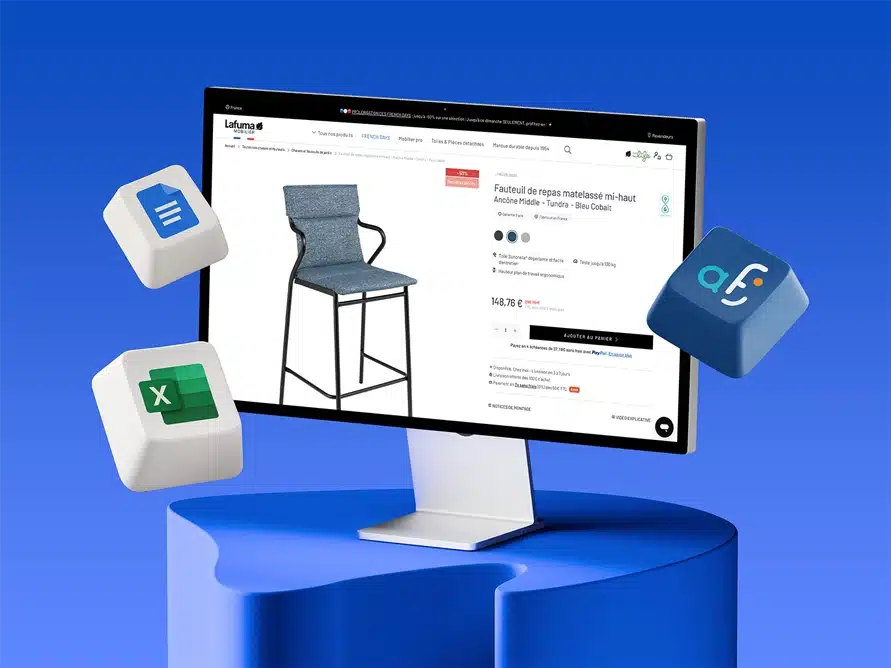
⚡ Quick definition of the PIM
A PIM lets you:
-
- centralize product data
- improve its quality
- adapt the information to each channel
- automate its syndication
With the multiplication of sales channels, digital catalogs, marketplaces and regulatory requirements, the quality of product information has become a central challenge for companies.
What does PIM mean?
PIM stands for Product Information Management, the management of product information.
What is a PIM for? Definition and role
A PIM serves to manage the whole value chain of product data. It is the central domain for product data in an omnichannel strategy.
It lets you collect information from different sources, ERP, suppliers, internal files, structure it, enrich it with marketing content and then syndicate it automatically to every channel.
The PIM does not replace your existing systems, it complements them.
For example, it works alongside the ERP.
⭢ Read also: PIM and ERP: why use a PIM if you already have an ERP?
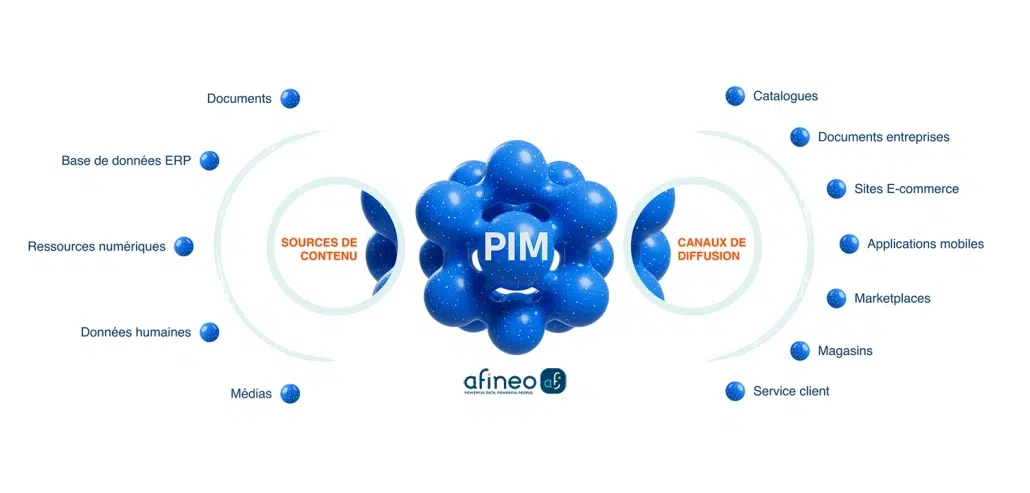
A little history: the origins of the PIM
To understand its strategic role today, let us go back to the source. The PIM concept emerged at the turn of the 1990s and 2000s, when the printed product catalog still reigned. The arrival of the internet and of the first e-commerce sites created a major break: companies used to a single communication channel had to harmonize their message on the web.
Manual management quickly became a headache. How do you guarantee consistency between the printed catalog and the online product records? The PIM was born from that need: creating a single domain to centralize product data, enrich it collaboratively and make its syndication reliable. Far from being a recent innovation, the PIM answers the growing complexity of omnichannel commerce.
🎬 Understand in video how a PIM centralizes product information.
This video explains how a PIM brings together product information from several sources, such as Excel, the ERP or supplier files, to create a reliable, shared domain.
⏱️ 5 min • Definition, workings and usage examples
Why use a PIM?
Using a PIM answers several major challenges.
With the multiplication of sales channels and the growing volume of product data, companies have to manage increasingly complex information.
A PIM lets you structure that data and avoid errors.
These gains have a direct impact on performance.
⭢ Calculate: the ROI of a PIM in 2 minutes
Why has the PIM become essential?
Historically, companies managed their product data in Excel or in their ERP. That approach suited a simple environment.
Today, the same product record has to be syndicated to several channels, sometimes in several languages, with specific constraints.
Without a dedicated domain, that leads to inconsistencies, errors and a significant loss of time.
It is in this context that the PIM established itself as a pillar of product information management.
The challenges of managing product information
Growing complexity of product data
Companies have to manage an ever-growing volume of data, spread across multiple channels and formats. That complexity makes manual management inefficient and risky.
Stronger regulatory requirements
Product information must now display mandatory notices:
- Allergens
- Repairability index
- Energy consumption
- Environmental characteristics, for example the AGEC law
- Specific rules for promotions, sales periods and bundles
A product experience that has become strategic
The customer experience starts with the quality of the product information. Incomplete or inconsistent data directly affects conversion and revenue.
In this context, managing product data with Excel quickly becomes unsuitable: it is time-consuming, error-prone and hardly compatible with time-to-market requirements.
An operational headache without a structured domain
Companies today manage thousands of SKUs, often multichannel and multilingual.
Without a structured organization of product data, management becomes a real operational headache and a source of errors.
What a modern PIM makes possible
A PIM answers these challenges concretely by letting you:
- centralize all product data in a single domain;
- standardize the information across every channel: website, ERP, marketplaces, catalogs or outlets;
- automate the update and syndication of product records;
- reduce time to market;
- improve data quality to make the product experience reliable.
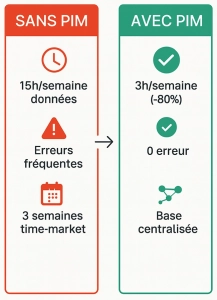
A PIM simplifies the management of product data and secures its syndication across every channel. It helps business teams gain efficiency, limit errors and make their product records reliable.
How does a PIM work?
A PIM works through a structured cycle of product data management, from collection to omnichannel syndication.
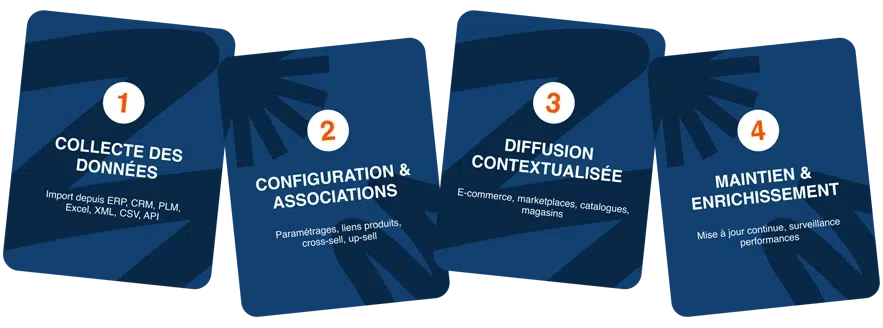
1. Data collection
Automatic import from ERP, CRM, PLM, suppliers or files such as Excel, XML and JSON. The built-in DAM centralizes all the digital assets: images, documents, media.
2. Structuring and enrichment
The data is normalized, enriched and linked to digital content. Business teams complete the product records with descriptions, visuals and SEO, and define the product relationships such as bundles and promotions.
3. Omnichannel syndication
Product information is syndicated in context to the various channels: e-commerce with Shopify or Magento, marketplaces such as Amazon, print catalogs, digital materials or outlets.
4. Continuous update and enrichment
The product database evolves constantly to stay reliable, compliant and effective as markets, regulations and commercial performance change.
⭢ Read also: 6 good practices for a successful PIM integration
Which data is managed by a PIM?
A PIM lets you manage all the information needed to create, sell and showcase your products.
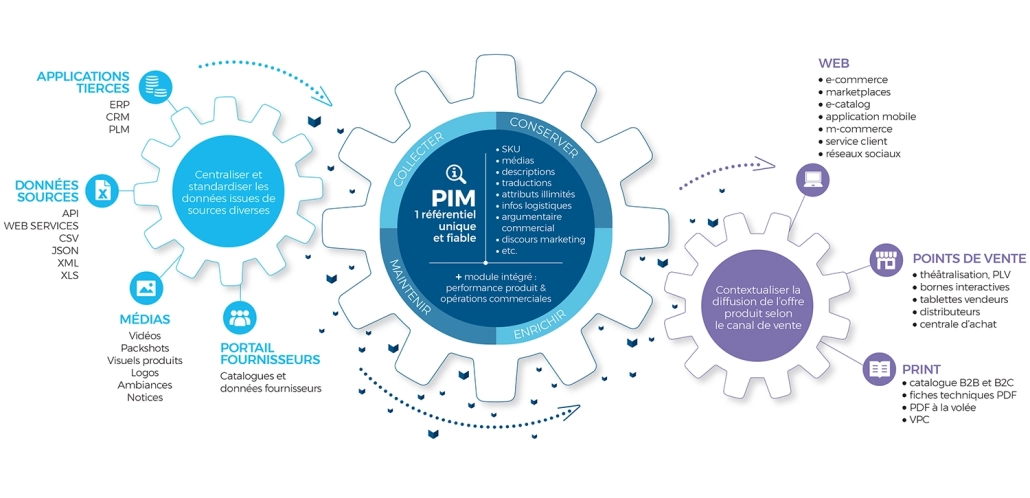
It lets you manage in particular:
1. Essential product data
Descriptions, technical characteristics, references such as SKU and GENCOD, brand, variants, multilingual translations and regulatory notices.
2. Media and digital content
Images, packshots, videos, PDF documents, labels and certifications, centralized through a built-in DAM.
3. Commercial data
Prices, currencies, taxes, terms of sale, performance per channel, margins and seasonality.
4. Logistics data
Dimensions, packaging, storage, transport, availability and stock management.
5. Enriched and marketing content
SEO, cross-selling, up-selling, product recommendations and contextualized offers.
6. External and market data
Customer reviews, user content, competitive information, supplier data (Supplier Master Data Management) and market positioning.
⭢ Read also: product database, definition, challenges and implementation
PIM, DAM, MDM and ERP: what are the
differences?
To place the PIM in your technology ecosystem, let us clarify the different acronyms.
| SYSTEM | Role | Data managed |
|---|---|---|
| PIM Product Information Management |
Centralizes the product information intended for sales and marketing | Descriptions, technical characteristics, mandatory notices |
| DAM Digital Asset Management |
Manages digital resources and media files | Image files, lifestyle photos, logos, packshot visuals, usage videos, instruction sheets |
| MDM Master Data Management |
Centralizes all the strategic data of the company | Products, customers, suppliers, outlets (the PIM is a sub-domain of the MDM) |
| ERP Enterprise Resource Planning |
Complementary to the PIM | Stock and sales performance information, retrieved into the PIM |
Compare:
⭢ PIM and DAM: differences and complementarity
⭢ MDM or PIM: what is the difference?
What are the key benefits for the company?
A PIM generates measurable gains across the whole product chain, from marketing to sales.
- Faster time-to-market
Product records created and put online faster thanks to automation. - Reliable, compliant data
Consistent, complete information that meets market requirements and regulations. - A stronger product experience
Consistent content, put in context for each channel and each audience. - Productivity and lower costs
Fewer manual tasks, automated flows and better collaboration between teams. - Commercial performance and international growth
Better conversion rates, a wider offering and multi-country, multilingual management. - Anticipating regulations (DPP, Digital Product Passport)
Data structured to meet the requirements of the Digital Product Passport and future regulatory obligations. - A differentiating product experience (PXM)
Enriched content to create an engaging product experience, improve conversion and build the brand.
⭢ See also: understanding the benefits of a SaaS PIM
⭢ Discover the concrete benefits of a PIM
A concrete example of using a PIM
Take a distributor managing several thousand SKUs across different sales channels.
Without a PIM, every product update has to be made manually on each channel, with a high risk of errors and inconsistencies.
With a PIM, the data is centralized, enriched and then syndicated automatically to every channel.
The result: fewer errors, a faster time-to-market and a consistent product experience across all channels.
⭢ See concrete cases: the facets of the PIM for an omnichannel strategy
Which companies use a PIM?
Manufacturers, distributors, retailers and online sellers use a PIM to structure their product data, improve its reliability and syndicate it more easily across several channels.
Manufacturers
A manufacturer can use the PIM to give its partners a B2B portal centralizing all of its product data.
The result: information that is always up to date, better responsiveness and a smoother commercial relationship with distributors.
Distributors
Distributors make full use of the potential of the PIM to gain efficiency and competitiveness.
In particular, they can:
- Collect data through a supplier portal
- Link data and assets through a PIM and DAM approach
- Build offers based on commercial performance
- Feed the sales tools: tills, tablets, kiosks
- Quickly produce catalogs and sales materials
Industrial companies (FAB-DIS format)
In industrial sectors, the PIM makes data exchange in the FAB-DIS format easier. The PIM also fits the BIM requirements of the construction sector.
⭢ Connectors let you automate the generation and transmission of data, with no manual handling.
Online sellers
Digital players use the PIM for e-commerce in order to:
- Centralize product information and assets
- Structure and enrich product records
- Syndicate to e-commerce sites and marketplaces
- Adapt the content per channel
- Optimize sales through cross-selling and up-selling
Do you necessarily need a PIM?
Not every company needs a PIM.
However, as soon as managing product data becomes complex, with more channels, more SKUs or more markets, it becomes a key lever of performance.
⭢ Complete guide: PIM comparison France 2025
⭢ Succeeding with your project: the keys to a successful PIM project
How do you approach a PIM project?
Deploying a PIM is not limited to choosing a tool. It means clarifying the objectives, structuring the product domain, identifying the data sources, defining the contribution rules and supporting the business teams.
The main stages are usually:
- define the objectives and the expected gains;
- analyze the business needs and the existing processes;
- structure the families, attributes and management rules;
- organize the data migration and enrichment;
- connect the distribution channels;
- support the teams over time.
To go deeper, read our guide to succeeding with a PIM project.
FAQ: frequent questions about the PIM
What is the difference between a PIM and an Excel spreadsheet?
An Excel spreadsheet lets you manage product information manually, but it quickly becomes limited as soon as the data, the channels or the users multiply. A PIM centralizes product information, structures the attributes, secures the updates and makes syndication to e-commerce sites, catalogs, marketplaces or distributors easier. To go further, discover the role of PIM software in product data management.
What is the difference between a PIM and a DAM?
A PIM manages product data: descriptions, characteristics, translations, classifications, technical or logistics information. A DAM manages the assets linked to the products: images, videos, instruction sheets, PDF files or marketing visuals. To understand how they complement each other, read our article on the difference between PIM and DAM.
What is the difference between a PIM and an ERP?
An ERP mainly manages the internal processes of the company: purchasing, stock, orders, invoicing or production. The PIM focuses on the product information intended for marketing, e-commerce and sales teams and for the distribution channels. The two tools are therefore complementary: discover how to combine ERP and PIM in your organization.
What is the difference between a PIM and an MDM?
An MDM lets you govern several data domains in the company, such as products, customers, suppliers or outlets. A PIM is more specifically focused on enriching and syndicating product information. To go deeper, read our article on the difference between MDM and PIM.
Who uses a PIM day to day in the company?
A PIM is used by marketing, product, e-commerce, procurement, sales, data and communications teams. Each of them contributes to the quality of the product information: enriching the records, approving the content, translating, syndicating or checking consistency. This is one of the great benefits of a PIM for business teams.
When should you deploy a PIM?
A PIM becomes useful when product information is scattered, hard to maintain or different from one sales channel to another. That is often the case when a company manages many SKUs, several brands, several languages, several countries or many distribution materials. To frame the key stages, discover our advice for succeeding with a PIM project.
What does a PIM project cost?
The cost of a PIM project depends on the number of SKUs, the complexity of the data, the connectors required, the workflows, the users and the level of support expected. To assess it properly, you have to take into account the software, the integration, the data migration and the expected operational gains. You can also calculate the ROI of a PIM to estimate the value of the project.
What is a PIM in e-commerce?
In e-commerce, a PIM lets you centralize and enrich product records before syndicating them to a merchant site, marketplaces or digital catalogs. It helps guarantee reliable, complete and consistent information across every sales channel. This is a key use of a PIM solution for e-commerce.
Resources to go further with the PIM
Would you like to explore a specific subject around Product Information Management? Find our complementary guides to better understand the uses, the differences with other tools and the key stages of a PIM project.
Understanding the fundamentals of the PIM
- Discover the Afineo PIM page
- Discover the benefits of a PIM
- Structure a product domain
- Understand the role of the Product Information Manager
Compare the PIM with the other tools of the data ecosystem
- Understand the difference between PIM and DAM
- Understand how ERP and PIM complement each other
- Understand the difference between MDM and PIM
Prepare and succeed with a PIM project
- Succeed with a PIM project
- Understand PIM integration
- Manage sales channels with a PIM
- Train teams in data culture
 Afineo, a key player in reference data management, offers a SaaS MDM, PIM and DAM platform to support the digital transformation of businesses. Our multi-domain cloud solutions make data management and data quality easier, while ensuring smooth integration with your digital ecosystem.
