Calculate your PIM ROI in 2 minutes
Investing in a PIM (Product Information Management) represents an initial cost, but the gains are fast, measurable and lasting.
How much could your company save in time, resources and efficiency?
Find out in 2 minutes with our Afineo PIM ROI calculator.
Estimate your real gains
💡 New to the PIM? Read also: PIM solution: 7 concrete benefits and proven ROI
Our tool instantly estimates your potential gains based on your current situation:
- Volume of products managed
- Number of people involved
- Distribution channels
- Level of process automation
In 2 minutes flat, you get a personalized estimate of your PIM return on investment, based on the results observed at our customers.
How do we calculate your PIM ROI?
Our calculator uses a proven methodology based on the average results observed at our customers over 10 years. Here is how we estimate your gains:
Our methodology rests on 10 years of experience and the average gains observed at our customers.
We assess 4 main levers:
1. Productivity gain (50% to 80%)
The PIM automates data entry, updates and multichannel syndication.
👉 Less Excel, fewer errors, more added value.
Result: hundreds of hours saved every year.
2. Faster time-to-market (up to 75% faster)
Centralizing the data and synchronizing every channel lets you publish your products 4 times faster.
A product online sooner means more commercial opportunities.
3. Fewer product errors (up to –90%)
A single domain removes inconsistencies, missing visuals and incorrect prices.
👉 Fewer returns, fewer complaints, higher customer satisfaction.
4. ROI measured in months, not years
On average, our customers reach a return on investment between 3 and 9 months, depending on their volume and complexity.
Real ROI observed at our customers
Our customers in different sectors have measured concrete gains after implementing Afineo.
Here are representative anonymized examples:
Multi-brand online retailer, fashion sector
Before: 4 Excel files, 5 days to publish a product
After 4 months with Afineo:
- +65% productivity
- Time-to-market: 5 days to 1 day
- ROI reached in 4 months
- Annual saving: around €78,000
Industrial manufacturer, equipment sector
Before: scattered data, obsolete catalogs
After 8 months with Afineo:
- +80% productivity
- Personalized catalogs generated in 5 minutes
- Expansion into 12 countries
- ROI reached in 7 months, annual saving: around €210,000
On average, our customers measure a PIM ROI between 3 and 9 months, productivity up by 50 to 80%, and a 90% reduction in product errors.
5 factors that affect your PIM ROI
The return on investment of a PIM depends directly on your organization, your volumes and your digital maturity. Here are the major levers to know:
1. Volume of product SKUs managed
ROI impact: ⭐⭐⭐⭐⭐ (very high)
The larger your catalog, the greater the gain. Managing 500 products manually remains feasible, but beyond 2,000, Excel becomes a nightmare: errors, duplicates, slowness.
- < 1 000 produits : Estimated ROI: 6 to 12 months
- 1,000 to 10,000 products: estimated ROI: 4 to 8 months
- More than 10,000 products: estimated ROI: 3 to 6 months
The PIM automates updates, exports, translations and quality checks, all tasks that multiply with volume.
2. Number of distribution channels
ROI impact: ⭐⭐⭐⭐⭐ (very high)
Every channel adds a layer of complexity: consistency of visuals, prices, descriptions. A single e-commerce site means little risk. Five channels, between marketplaces, catalogs, exports, outlets and apps, means guaranteed chaos without a PIM.
Examples of channels:
- Your own e-commerce site
- Marketplaces: Amazon, Cdiscount, Fnac, eBay and more
- Printed catalogs
- Physical outlets: POS displays, labels, kiosks
- International exports and mobile apps
- Distributor portals
Golden rule: from 3 channels onward, a PIM becomes essential to guarantee data consistency.
3. Complexity of internal workflows
ROI impact: ⭐⭐⭐⭐ (high)
The more teams and back and forth your processes involve, the more value the PIM creates.
Simple workflow:
Procurement, marketing, publication
Moderate ROI
Complex workflow:
Procurement, product approval, marketing, translation, legal, management approval, adaptation per channel, publication
Very high ROI
The PIM structures the workflows, automates approvals and removes bottlenecks. The result: less friction, more flow.
4. Current level of automation
ROI impact: ⭐⭐⭐⭐ (high)
The gain is greatest if your current processes are manual. But even with partial tools, a PIM centralizes the flows and makes them reliable.
| Level of automation | Potential gain |
|---|---|
| 0% (all manual) | 70-80% |
| 20-30% (partial tools) | 50-60% |
| 40-50% (already structured) | 30-40% |
The PIM acts as a conductor between your existing systems, ERP, e-commerce, DAM and others, to smooth the exchanges.
5. International expansion
ROI impact: ⭐⭐⭐ (medium to high)
If you are targeting new markets, the PIM becomes a genuine growth accelerator.
- Without a PIM: 6 to 12 months to adapt records, translations and legal notices per country
- With a PIM: 2 to 4 weeks to launch a country, thanks to multilingual management and automatic adaptation rules
Result: an international time-to-market divided by 3 and consistent visibility across every market.
What is the average ROI of a PIM solution?
The average return on investment observed at our customers is between 3 and 9 months, with a median around 5 to 6 months. That period varies according to the size of your catalog, the number of channels and your internal processes.
- Fast ROI (3-4 months): large volumes (more than 25,000 products), many channels (5 or more), structured teams (10 people or more)
- Average ROI (5-7 months): standard volumes (1,000-25,000 products), several channels (3-5), mid-sized teams (5-10 people)
- Longer ROI (8-12 months): small catalogs (<1 000 produits), peu de canaux (1–2), équipes réduites (2–5 personnes)
These periods only take cost savings into account. If you add the revenue growth tied to opening new channels, international expansion or commercial responsiveness, the ROI often becomes even faster.
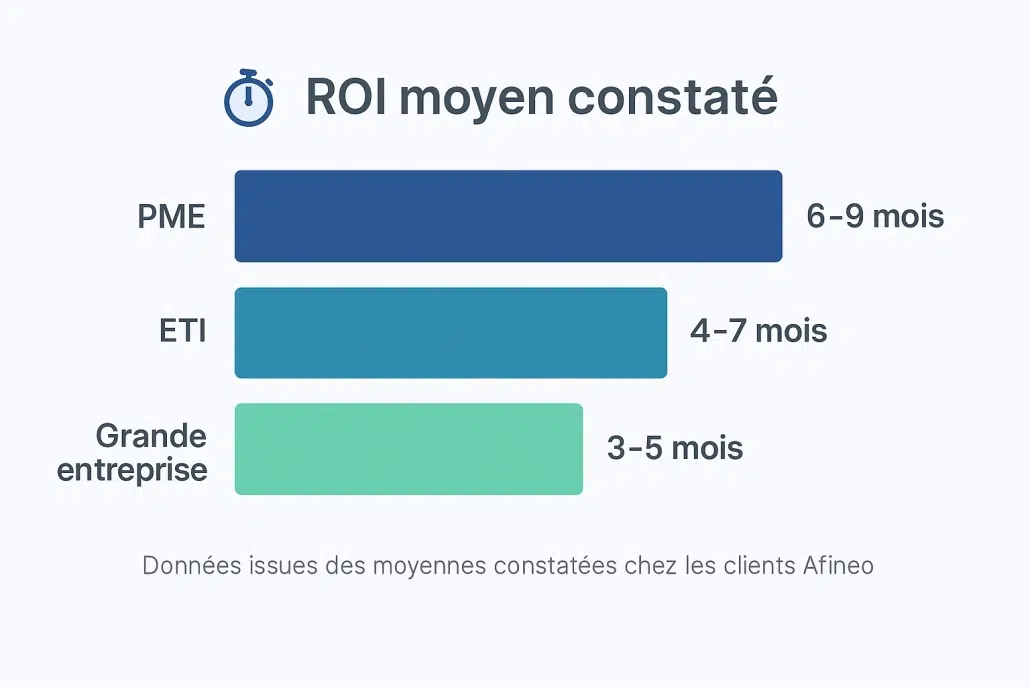
Figures drawn from the averages observed at Afineo customers.
How do you concretely measure your gains after implementation?
The key indicators to track your PIM ROI
To assess the ROI of your PIM objectively, it is essential to track KPIs before and after the deployment. Here are the main indicators to measure:
Productivity indicators
- Average weekly time per person spent managing data
- Number of hours to produce a catalog
- Response time to a commercial request, quote or proposal
Responsiveness indicators
- Average time to put a new product online
- Time to update a piece of information: price, stock, description
- Time to launch on a new sales channel
Quality indicators
- Error rate on product records, before and after
- Number of customer complaints linked to product data
- Completion rate of product records
Business indicators
- Number of active sales channels
- Number of SKUs managed
- E-commerce conversion rate, showing the impact of enriched product records
Afineo tip: measure these KPIs 3 months before the PIM project, then 3, 6 and 12 months after go-live, to see the real change.
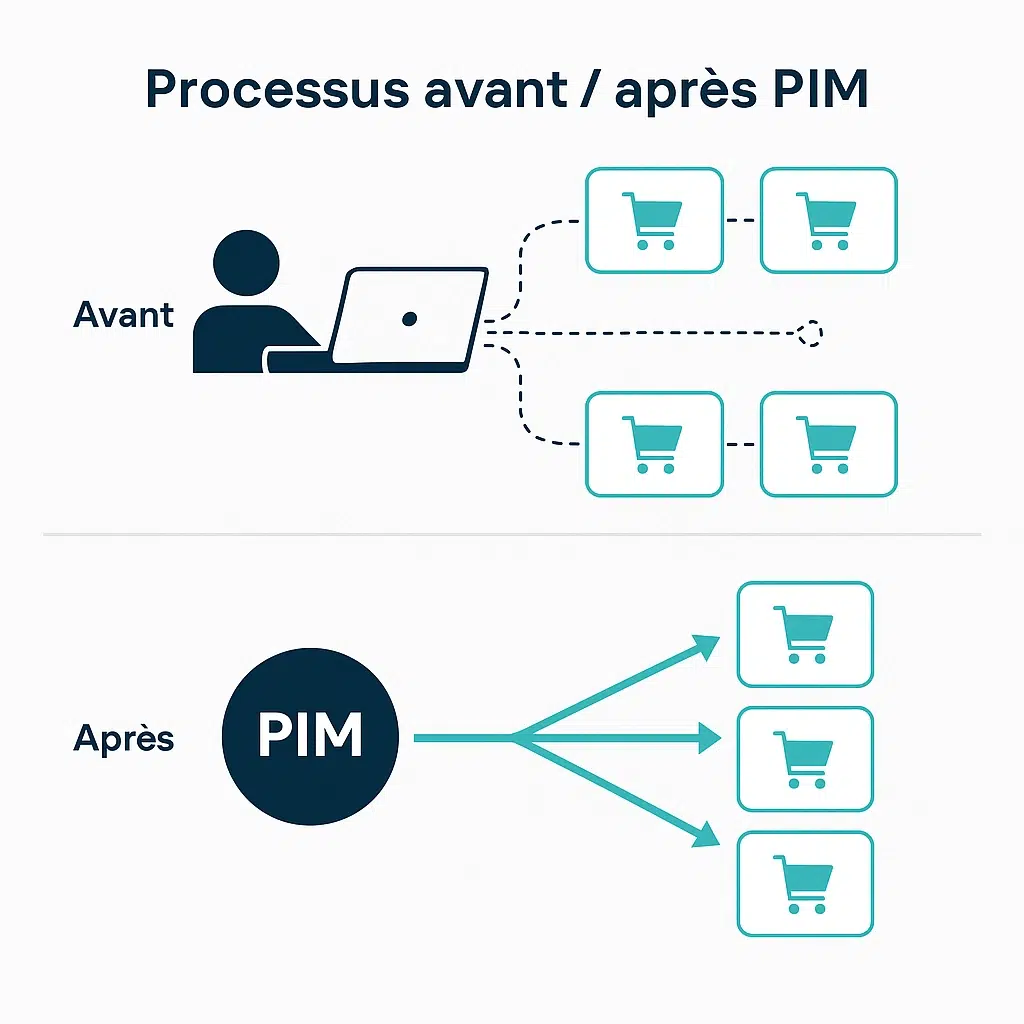
With Afineo PIM, your teams move from reacting to orchestrating.
Does a PIM really increase revenue?
Yes, but indirectly. A PIM does not create revenue by magic, it creates the conditions to grow it sustainably.
Factors that increase revenue
- More complete product records lead to a better conversion rate (+15% to +30% observed)
- More channels bring greater visibility and new customers
- Easier international expansion opens up new markets
- A reduced time-to-market means opportunities seized before the competition
- The ability to manage more SKUs widens the offering without hiring
Customer figures, anonymized
- Online retailer: +22% revenue after opening 3 marketplaces
- Distributor: +18% revenue after enriching 5,000 product records with HD visuals and videos
- Manufacturer: +35% export revenue after automated translation into 8 languages
The PIM is a performance catalyst, not a magic wand: it makes your teams more effective, your products more visible and your growth more scalable.
Is the ROI the same for a small business and a large enterprise?
No, the ROI varies, but both profiles gain significant benefits, for different reasons.
Large enterprise (more than €50M revenue)
- Advantage: massive economies of scale across volumes, channels and teams
- Average ROI: 3 to 5 months
- Main gain: lower operating costs, in the hundreds of thousands of euros
Small and mid-sized business (< 10 M€ CA)
- Advantage: agility regained and competitiveness against larger players
- Average ROI: 6 to 9 months
- Main gain: accelerated growth without additional hires
Both types of company gain in competitiveness and in ability to adapt. The difference lies in the scale of the savings, not in the profitability of the PIM.
What hidden costs should you plan for beyond the PIM license?
A well-scoped PIM project has no major hidden costs, but you should anticipate certain complementary investments for an effective deployment.
Budget to plan for
- PIM license: annual subscription depending on volume and features
- Implementation and configuration: support from the vendor and from an integrator
- User training: 3-5 days for administrator profiles, 1-2 days for business profiles
- Internal time: involvement of your teams in scoping, testing and acceptance
- Specific connectors: for rare tools not supported natively
- Initial enrichment: if your current data is incomplete
What Afineo includes in its offers
- Change management support
- Complete team training for full autonomy
- PIM configuration according to your needs
- Standard connectors for ERP, CMS and common marketplaces
- Continuous technical support
Tip: plan 5 to 10% of the total budget for possible adjustments. A project well prepared upstream strongly limits surprises.
Is the ROI of a PIM only financial?
No, the ROI goes well beyond the financial dimension. Companies observe strategic, human and operational gains that matter just as much.
Strategic gains
- Greater agility: responsiveness to market opportunities
- Easier expansion: new channels and countries reachable without friction
- Stronger competitiveness: reduced time-to-market against the competition
- Data-driven decisions: steering based on reliable data
Human gains
- Team satisfaction: fewer repetitive tasks
- Better collaboration: cross-functional work and a shared view
- Growing skills: focus on high-value tasks
- Less stress: fewer errors and fewer emergencies
Operational gains
- Data quality: a single, reliable, up-to-date domain
- Traceability: complete history of changes and approvals
- Regulatory compliance: mandatory notices added automatically
- Scalability: growth absorbed without an explosion in costs
These non-financial benefits are often cited by our customers as decisive in the success of the PIM project and in improving the daily life of their teams.
Do you have to prepare everything before launching a PIM?
No, definitely not! Waiting for perfection delays projects for nothing.
In reality, the PIM helps you clean and structure your data, formalize your processes and succeed with staged migrations.
The right method:
– Start with your current data
– Use the PIM to detect the gaps and refine your workflows
– Move forward in phases: key products first, the rest afterwards
Golden rule: perfect is the enemy of progress. Get started, then improve.
Ready to calculate your real gains?
You now know how a PIM generates a fast, measurable ROI.
Over to you!
1️⃣ Use the calculator above
Get a personalized estimate in 2 minutes, based on your situation.
2️⃣ Let us talk about your project
Let us discuss your context, your objectives and the concrete levers of performance.
👉 A one-hour conversation to identify your priorities and the first possible actions.
3️⃣ See Afineo in a live demo
See concretely how our PIM simplifies product management and accelerates your time-to-market.
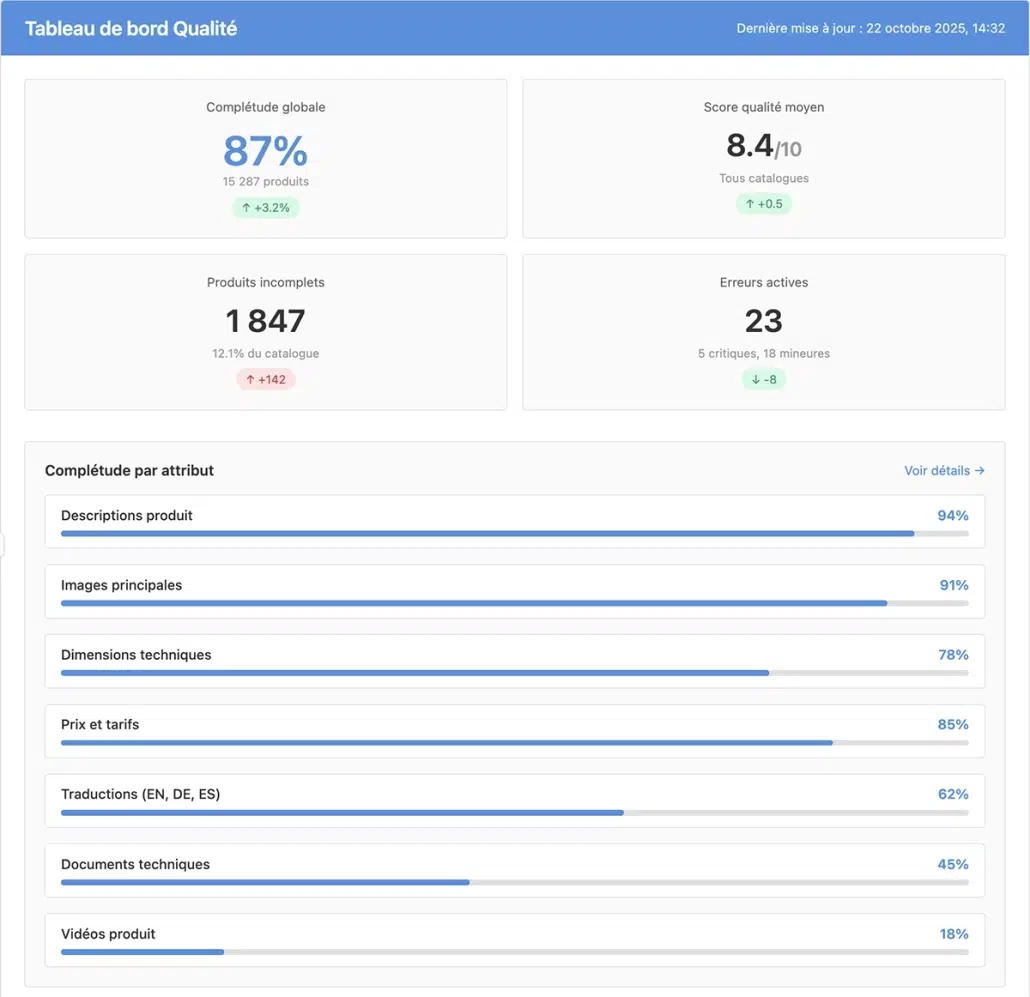
Example Afineo PIM dashboard helping teams visualize the completeness and reliability of product data.
To go further
Discover our other resources:
– What is a PIM? Complete 2025 guide: definition, how it works and detailed use cases
– [PIM solution: benefits & ROI](/solution-pim-avantages-roi/) The 7 strategic benefits of a PIM with customer testimonials
– PIM guides by role, specific benefits for marketing, sales, procurement and digital
– Afineo references and customer cases, detailed feedback by industry
FAQ – Calculating the ROI of a PIM
How do you calculate the ROI of a PIM?
The ROI of a PIM (Product Information Management) is calculated by comparing the savings generated on product data management, in time, errors and coordination, with the implementation costs.
On average, companies observe a return on investment between 3 and 9 months, depending on their size, their product volume and the number of distribution channels.
What are the main measurable gains with a PIM?
A PIM lets you cut up to 80% of the time spent managing products, accelerate time-to-market by 75%, and avoid 90% of data errors.
These gains translate into operational savings and better commercial performance.
Is the ROI of a PIM the same for a small business and a large group?
No, but both profiles gain a clear benefit:
-
Large enterprises get a fast ROI, 3 to 5 months, thanks to economies of scale.
-
Small and mid-sized businesses gain agility and productivity, with an average ROI of 6 to 9 months.
In every case, the PIM improves competitiveness and the capacity to grow.
How do you concretely track ROI after deployment?
Afineo recommends tracking KPIs before and after the PIM project:
- Product publication time
- Error rate on product records
- Data completion rate
- Number of active channels and speed of integration
These indicators let you measure the gains and the effectiveness of the PIM objectively.
Can a PIM increase revenue?
Indirectly, yes.
A PIM supports e-commerce conversion (+15 to +30%), the opening of new sales channels, international expansion and better commercial responsiveness.
It is a growth accelerator, not only an organizational tool.
To go further
Discover our other resources:
– Explore the Afineo PIM solution →
– PIM guides by role, specific benefits for marketing, sales, procurement and digital
– Afineo references and customer cases, detailed feedback by industry
 Afineo, a key player in reference data management, offers a SaaS MDM, PIM and DAM platform to support the digital transformation of businesses. Our multi-domain cloud solutions make data management and data quality easier, while ensuring smooth integration with your digital ecosystem.
