• The Platform
    • REFERENCE DATA
      • Multi-Domain MDM Governance & data quality
      • Espace
      • Group Multi-Entity MDM Data consolidated across subsidiaries
      • Espace
      • PIM software Centralized product information
      • Espace
      • Multi-domain PIM Cross-reference your product data
      • Espace
      • DAM Assets & digital media
    • SYNDICATION & PRODUCTION
      • Publishing Automated catalogs
      • Espace
      • Afineo Online Proof Approval Digital, controlled proof approval
      • Espace
      • Print-in-Store Customized in-store signage
      • Espace
      • Supplier Portal 24/7 data collection
      • Espace
      • Distributor Portal Self-service catalog
    • INTELLIGENCE & ANALYTICS
      • NEO AI The AI that understands, enriches and activates your product data
      • Espace
      • Product Performance and Sales Campaigns Sales campaigns & unsold stock
      • Espace
      • Distribution Network Management Steer your network performance, store by store
      • Espace
      • The Afineo Platform: Overview An overview of every solution Explore →
    • Request a demo
      • Request a demo
  • Your Challenges
    • BY INDUSTRY
      • Fabricants Multichannel & domains
      • Espace
      • Distributors Catalog performance
      • Espace
      • Consumer Goods FMCG & data syndication
      • Espace
    • BY CHANNEL
      • PIM to E-commerce Product records that convert
      • Espace
      • PIM to Marketplaces Amazon, Cdiscount, FNAC…
      • Espace
      • PIM to SEO Structured data & rankings
      • Espace
    • BY ROLE
      • Product Manager
      • Marketing
      • Communications
      • IT
      • Digital
      • Procurement
      • Sales Teams
    • Request a demo
      • Request a demo
  • Resources
    • LEARN
      • Blog
      • Espace
      • What is a PIM?
      • Espace
      • What is a DAM (Data Asset Management)?
      • Espace
      • Master Data Management: definition, challenges and solutions
      • Espace
      • Glossary
    • EVALUATE
      • PIM Benefits Concrete benefits for retailers and manufacturers
      • Espace
      • Calculate my PIM ROI Estimate your gains in 2 minutes
      • Espace
      • Espace
      • SERVICES
      • Espace
      • API Documentation
    • Request a demo
      • Request a demo
  • Afineo
      • About Us French SaaS vendor since 2004
      • Espace
      • Customer References References & testimonials
      • Espace
      • SERVICES
      • Espace
    • Request a demo
      • Request a demo
  • Afineo AI
  • Request a demo
  • English
    • French
  • Menu Menu
  • Request a demo
  • Our SaaS Solutions
    • NEO AI: the AI that really knows your product data.
    • The Afineo Platform: Overview
    • Multi-Domain MDM
    • Group Multi-Entity MDM
    • PIM software
    • Multi-domain PIM
    • DAM
    • Product Performance and Sales Campaigns
    • Distribution Network Management
    • Distributor Portal
    • Print-in-Store
    • Product Performance and Sales Campaigns
    • Publishing
    • Afineo Online Proof Approval
    • Print-in-Store
    • Supplier Portal
    • Distributor Portal
  • Your Challenges
    • PIM to E-commerce
    • PIM to SEO
    • PIM to Marketplaces
    • Distributors
    • Fabricants
    • Consumer Goods
    • Roles
  • Resources
    • Blog
    • PIM Guides
      • What is a PIM?
      • Why a PIM? 7 concrete benefits for your company
      • Calculate your PIM ROI in 2 minutes
    • What is a DAM (Data Asset Management)?
    • Master Data Management: definition, challenges and solutions
    • Glossary
    • SERVICES
    • API Documentation
  • Afineo
    • About Us
    • SERVICES
    • Customer References
  • English
    • French

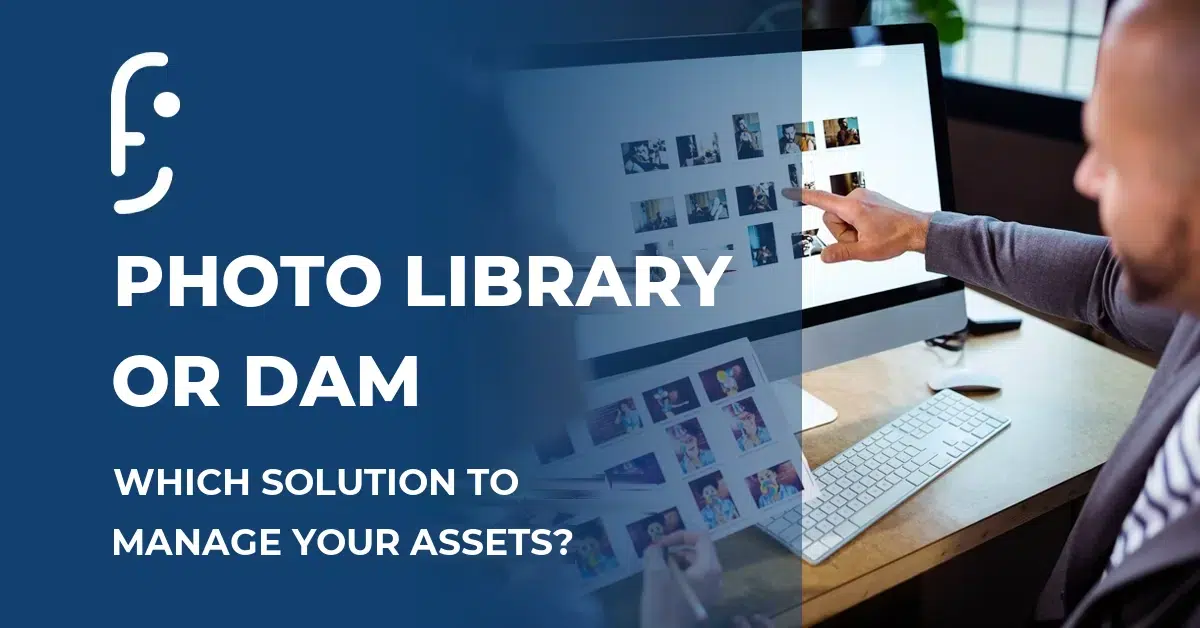
Media library or DAM: which solution should you use to manage your assets?
DAM - Digital Asset Management
Comparison of a media library and DAM software for managing assets
⏱ Reading time: 5 minutes

Published on 29 March 2026

You store your product visuals in a shared folder. Your communications manager has their own folder tree on the server. The external agency is working from a version of the logo that may no longer be the right one. And finding the HD packshot of a product launched 18 months ago? Count on 20 minutes at least.

If that situation sounds familiar, you are not alone. Many companies still manage their assets with a basic media library or, worse, with no dedicated tool at all. It works, right up to the moment it does not.

So at what point does a media library stop being enough? And what does a DAM bring in concrete terms by comparison? Here are the clear answers.


What is a corporate media library?

A media library is first and foremost a centralized storage space for image files. It lets you sort visuals into folders, share them with colleagues or service providers, and reach them from a browser or an internal network.

It is useful. It is simple. And for a small organization with a limited volume of visuals and few people involved, it can be enough.

But a classic media library has structural limits that you always end up hitting:

  • It mainly handles images, rarely video, audio, PDF or technical documents
  • Search is basic: you search by file name or by folder, not by metadata
  • There is no copyright management and no alerting on licence expiry dates
  • No approval workflow: there is no way to know whether a visual is approved, pending or obsolete
  • Distribution is manual: you download, you send, you start again

For a marketing team managing hundreds of product items across several channels, these limits quickly become daily operational brakes.


What is a DAM?

A DAM (Digital Asset Management) is a platform dedicated to managing the complete life cycle of all your digital files. Not only images: videos, logos, audio, jingles, technical datasheets, PDFs, packshots, lifestyle visuals, your whole digital estate in one place.

But a DAM is not just a big, tidy shared folder. It is a tool structured around three pillars:

Centralize: a single reference point, accessible to every team concerned (marketing, communications, digital, photo studio, external agencies), with finely configurable access rights.

Organize: each file is enriched with customizable metadata (keywords, rights, validity dates, usage context, format, language), which makes search instant and precise.

Distribute: assets are pushed automatically to the right channels, in the right formats, at the right time: e-commerce site, marketplace, print catalog, social media, distributor portal.

To go further on the definition, read our complete guide to the DAM.


Media library vs DAM: the comparison in 6 key points

Criterion Media library DAM
File types handled Mainly images Images, video, audio, PDF, technical docs
Metadata management Basic (name, folder) Advanced and fully customizable
Rights and licences Manual or absent Automated with expiry alerts
Approval workflow Absent Configurable to your business processes
Multichannel distribution Manual Automated, multi-format
PIM / e-commerce integration Rare Native in the Afineo platform

3 signals that you need a DAM

1. Your teams waste time looking for the right version of a visual

“Is it logo_v2_final_FINAL.ai or logo_v3_ok_approved.ai?” If that question circulates in your exchanges, you have an asset governance problem. A DAM removes that kind of situation: a single reference version, visible and accessible to everyone, with a history of archived versions.

2. You manage copyrights or validity dates on your assets

Using a visual whose licence has expired exposes the company to real legal risk. A media library does not handle that. A DAM includes native rights management, with automatic alerts before expiry and, where needed, a block on distribution.

3. You distribute your assets across several channels

E-commerce site, marketplace, print catalog, social media, distributor portal: each channel has its own constraints of format, weight and resolution. Adapting each visual by hand for each destination is time-consuming and error-prone. A DAM automatically generates the variants needed and pushes the right formats to the right places.


What if your DAM were natively integrated with your PIM?

This is where the “media library or DAM” question takes on an extra dimension for companies managing a product catalog.

A media library is disconnected from your product data. A standalone DAM often is too, which forces costly and fragile interfacing work. Real operational power comes from a DAM natively integrated with your PIM: assets are attached directly to product records, updates propagate automatically across every channel, and your teams work in a single interface.

That is exactly what the Afineo DAM solution offers: a DAM natively integrated into the PIM/MDM platform, with no interfacing to build, no double entry, no friction.

To understand how PIM and DAM complement each other, read our article on the differences between PIM and DAM as well.


In summary

A media library answers a simple need: storing and sharing images. A DAM answers a strategic need: centralizing, organizing, controlling and distributing your whole digital estate, at scale, across all your channels.

If your company manages a product catalog, several brands, several sales channels or several teams working on the same assets, the question is not really “media library or DAM?”, but “how much longer can I do without a DAM?”

Want to see in concrete terms what the Afineo DAM can bring to your teams? Request a demo and our experts will show you the platform on your own real use cases.

Armelle Allegret, CEO d Afineo Solutions - Experte PIM MDM DAM

Armelle Allegret

Co-fondatrice d’Afineo, 25 ans d’expertise marketing au service des entreprises pour transformer leur gestion de l'information produit (PIM, DAM, MDM) en avantage concurrentiel.
Son obsession : des contenus produits clairs, fiables et efficaces.
Implementing a DAM: 7 unmistakable signals

DAM vs MRM: what are the differences and where should you start?

Share this entry
  • Share on Facebook
  • Share on X
  • Share on WhatsApp
  • Share on LinkedIn
  • Share by Mail
https://www.afineo.com/wp-content/uploads/2026/08/dam-vs-phototheque-gestion-medias-afineo-en.webp 628 1200 Armelle Allegret https://www.afineo.com/wp-content/uploads/2024/09/logo-afineo-svg.svg Armelle Allegret2026-03-29 13:38:412026-08-26 12:10:57Media library or DAM: which solution should you use to manage your assets?

Sommaire

What if your product data became
a competitive advantage?

Since 2004, Afineo has been helping distributors, retailers and online sellers
centralize, validate and syndicate their product data.

Request a demo

Afineo, a key player in reference data management, offers a SaaS MDM, PIM and DAM platform to support the digital transformation of businesses. Our multi-domain cloud solutions make data management and data quality easier, while ensuring smooth integration with your digital ecosystem.

Who we are
Careers
Follow us:
Afineo sur LinkedIn

(+33) 9 72 10 11 72
contact{at}afineo.com
Lyon 69002
Voiron 38500

© Copyright - Afineo - SaaS PIM • DAM • MDM multi-domain platform - Sitemap - Legal notice - Privacy policy - Cookie policy - API
  • Link to LinkedIn
  • Link to Mail
  • Link to X
  • Link to Instagram
  • Link to Facebook
  • Link to Youtube
Scroll to top Scroll to top Scroll to top

Les cookies nous permettent d'améliorer votre expérience sur notre site et de vous fournir des services plus personnalisés.

AccepterRefuserParamètres

Cookie and Privacy Settings


Comment nous utilisons les cookies

Ce site Web utilise des cookies. Les cookies nous permettent de personnaliser le contenu et les annonces, d'offrir des fonctionnalités relatives aux médias sociaux et d'analyser notre trafic. Vous consentez à nos cookies si vous continuez à utiliser notre site Web. Nous pouvons demander que les cookies soient réglés sur votre appareil. Nous utilisons des cookies pour nous faire savoir quand vous visitez nos sites Web, comment vous interagissez avec nous, pour enrichir votre expérience utilisateur, et pour personnaliser votre relation avec notre site Web.

Cliquez sur les différentes rubriques de la catégorie pour en savoir plus. Vous pouvez également modifier certaines de vos préférences. Notez que le blocage de certains types de cookies peut avoir une incidence sur votre expérience sur nos sites Web et les services que nous sommes en mesure d'offrir.

Cookies Web Essentiels

Ces cookies sont strictement nécessaires pour vous fournir des services disponibles sur notre site Web et d'utiliser certaines de ses fonctionnalités.

Puisque ces cookies sont strictement nécessaires pour livrer le site, vous ne pouvez pas les refuser sans impact sur la façon dont notre site fonctionne. Vous pouvez les bloquer ou les supprimer en changeant les paramètres de votre navigateur et forcer le blocage de tous les cookies sur ce site. Plus d'information sur http://www.allaboutcookies.org/fr/

Cookies Google Analytics

Ces cookies collectent des informations de manière compilée pour nous aider à comprendre comment notre site est utilisé et combien son performantes nos actions marketing, ou pour nous aider à personnaliser notre site afin d’améliorer votre expérience de navigation.

Si vous ne souhaitez pas que votre visite soit pistée sur notre site vous pouvez bloquer ce pistage dans votre navigateur ici :

Autres services externes

Nous utilisons également différents services externes comme Google Webfonts, Google Maps, autres hébergeurs de vidéo. Depuis que ces FAI sont susceptibles de collecter des données personnelles comme votre adresse IP nous vous permettons de les bloquer ici. merci de prendre conscience que cela peut hautement réduire certaines fonctionnalités de notre site. Les changement seront appliqués après rechargement de la page.

Réglages des polices Google :

Réglages Google Map :

Réglages reCAPTCHA :

Intégrations de vidéo Vimeo et Youtube :

Politique de Confidentialité

Vous pouvez lire plus de détails à propos des cookies et des paramètres de confidentialité sur notre Page Mentions Légales.

Privacy policy
Accepter les réglagesMasquer uniquement les notifications