PIM and DAM 2025: Differences, Complementarity and Buyer’s Guide
PIM and DAM: the answer in 30 seconds
The PIM (Product Information Management) centralizes all the text data about your products: descriptions, prices, dimensions, technical characteristics, legal notices.
The DAM (Digital Asset Management) organizes all your multimedia files: product photos, videos, logos, PDFs, user manuals.
Used together, they create a single source of truth that:
– Cuts the time spent creating product records by 70%
– Raises the e-commerce conversion rate by 25%
– Eliminates errors and inconsistencies between channels
In short: the PIM handles the “WHAT” (information), the DAM handles the “HOW” (visuals). Together, they showcase your offer across every sales channel.
Calculate your PIM/DAM ROI in 2 min
—
PIM and DAM are two different, complementary solutions that allow many companies to meet the challenges of product data management.
Manufacturers and industrial companies, distributors and retailers, mass-market players and e-merchants all use these two tools together to make their exchanges of information and data easier.
The end goal: to showcase the commercial offer across every sales channel and drive product sales, thanks to complete information and convincing marketing content.
Take an informed view of Product Information Management and Digital Asset Management in order to maximize your product performance.
The PIM: for managing product information
What is a PIM? Read our dedicated guide to find out everything about PIM software.
Definition and characteristics
The acronym PIM stands for Product Information Management, in other words the management of product information.
It is a technology designed to manage complex data architectures for product information, including data inheritance.
The PIM is characterized by its ability to centralize all the information about the products a company sells, coming from an ERP, a PLM tool or .CSV files for example. A single, high-quality domain is then built in order to syndicate that information across sales channels.
Objectives of a PIM solution
Every business team works from the same source of truth in order to meet consumer expectations: detailed information, consistent display across every channel, mandatory legal notices, with no duplicates and no errors.
Excellent PIM software such as the Afineo SaaS PIM lets you syndicate information across multiple media thanks to numerous connectors and add-on modules: e-commerce site, marketplaces, catalog for print, in-store signage kit, PDF file, in-store digital tools and more.
Types of data managed
A PIM solution allows the management of information relating to products:
- long and short descriptions,
- description by channel, by brand, product line, size, color, material and so on,
- management of product offers,
- logistics constraints,
- mandatory legal notices
- and so on.
A PIM brings many concrete benefits to the company:
Main benefits
- centralization and validation of information,
- reduced time-to-market,
- easier collaboration,
- increased productivity,
- reliable, consistent data syndication,
- enrichment of every piece of content,
- unique text optimized for organic search (SEO),
- descriptions put in context according to the sales channel,
- product experiences that trigger the purchase,
- Supplier Portal (Afineo platform),
- manufacturer B2B portal (Afineo platform).
The DAM: for managing digital assets
What is a DAM? Read our dedicated guide to find out everything about the DAM platform.
Definition and characteristics
The acronym DAM stands for Digital Asset Management, in other words the management of digital resources, also called digital assets.
It is a technology dedicated to managing the lifecycle of assets, including metadata and versioning.
The DAM is characterized by its ability to centralize all multimedia files such as logos, product photos and videos, sound, music, and other documents such as user manuals in particular. An exclusive domain is then used to syndicate the right digital resources across sales channels in order to showcase the product offer.
Objectives of a DAM solution
By working from a single database, managers syndicate consistent digital assets and strengthen the brand image: product packshots, lifestyle visuals, the breadth of the product line and more.
Excellent DAM software such as that of the Afineo SaaS platform lets you syndicate multimedia files to a high standard and automatically, across the same media and channels as the PIM solution.
Types of data managed
A DAM solution allows the management of digital files and assets relating to:
- products,
- organizations,
- labels and certifications,
- photo rights,
- legal obligations (environmental labelling under the French AGEC law, for example)
- and so on.
Main benefits
- centralization and validation of assets and files,
- built-in copyright management,
- metadata management for organic search,
- indexing, preservation and capitalization of the company’s digital heritage,
- easier internal and external collaboration,
- management of file access,
- guaranteed confidentiality,
- secure sharing and syndication,
- control of the brand image.
Differences between PIM, DAM, MDM and PLM
PIM vs DAM: we have just seen the differences between a PIM and a DAM. Beyond that, MDM, PIM, DAM and PLM tools must not be confused with one another. Here are a few explanations to make things clear.
Table of differences between PIM, DAM, MDM and PLM
| Software | What the acronym stands for | Use and purpose |
|---|---|---|
| PIM | Product Information Management, the management of product information. | Build a single domain for product information and syndicate that information across sales channels. |
| DAM | Digital Asset Management, the management of digital resources and multimedia files. | Build a single domain for digital assets and syndicate the files across sales channels. |
| MDM | Master Data Management, the management of reference data, also called master data. | Build several domains and cross-reference the data to make the best business decisions. |
| PLM | Product Lifecycle Management, the management of the product lifecycle. | Manage the product’s life stages from design through to recycling. |
PIM and DAM: product data management at the heart of business challenges
Why is the Yuka mobile app such a success, with its 48 million users (figures from March 2024, Google Play)?
The answer: whatever their final purchase channel, in a physical store or online, 93% of consumers research on the internet, and 78% expect complete, detailed information so they can compare products on the web.
You cannot afford to miss the transparency appointment with the customer, because revenue depends on it: 87% will never again buy from a retailer that gave them inaccurate information (source).
The condition for keeping that appointment: delivering a rich product experience, making sure you syndicate convincing content and complete information on product records, printed catalogs, in-store signage kits and so on. PIM and DAM software together make it possible to create and syndicate product records that trigger sales.
Let us look at an example of a product experience on video, to understand what is at stake with the data attached to every item put on sale:
PLM and product lifecycle management
Product Lifecycle Management (PLM) concerns the management of the product lifecycle. This solution is used to manage every stage of design and product creation, including the manufacturing phase in particular.
PIM and DAM then take over to drive the marketing of products across sales channels. PIM, DAM and PLM do not come in at the same stages.
MDM: the multi-domain approach
MDM, for Master Data Management, refers to the management of reference data, or “master data”. An MDM platform is made up of several domains, unlike a PIM or a DAM, which are each a single domain.
MDM can, for example, make it possible to add a supplier domain so a distributor can collect their data more easily. Conversely, a manufacturer can build its own B2B portal to make it easier for its distributor customers to list its products, by giving them permanent, secure, personal access to its domain.
Worth knowing: the Afineo SaaS platform natively includes the PIM, DAM and MDM solutions so companies can equip themselves according to their current challenges, but also their future ones: every module is available within the platform and they are complementary.
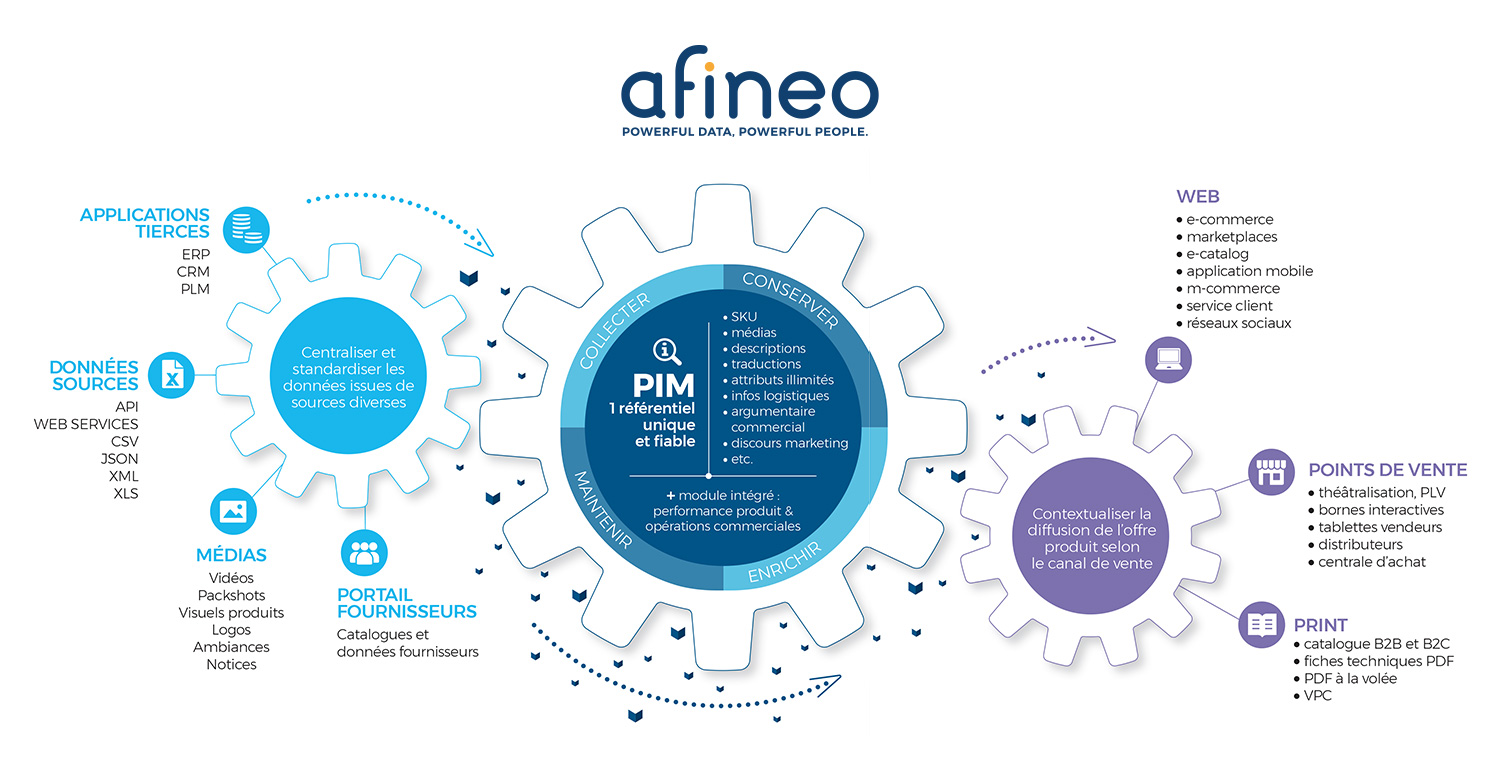
Here is a simplified diagram of the Afineo platform:
PIM and DAM solutions: technological complementarity to accelerate your business
Pairing PIM and DAM brings many competitive advantages. Let us look at how the PIM and DAM solutions brought together within the Afineo platform help you manage the abundance of product information and digital resources, and put a competitive omnichannel strategy in place.
PIM and DAM natively interconnected
This is one of the great advantages of the Afineo SaaS ecosystem: PIM and DAM are built on a common core of features that lets them communicate smoothly, natively, from the same interface.
Here are a few concrete examples illustrating the complementarity of the PIM and the DAM:
- You can automatically attach assets to product records from the PIM.
- You can attach product information to assets, from the PIM to the DAM, automatically.
- You classify a large number of product records or asset records in fine detail.
- You build on the work done upstream in the PIM and carry it through into the DAM.
- You can bring information back in both directions.
- You can link several visuals to one product, several visuals to several products, a single visual to several products,
- You can change a piece of information on the fly at any time, on the PIM side or the DAM side.
Syndicating the offer across sales channels simultaneously
Afineo’s founders bring more than 20 years of proven experience in the production chain for print and for e-commerce. Aware of the challenges and of the many problems involved, we designed and developed the Afineo platform drawing on a multitude of experiences lived in the field.
The product PIM, with its native DAM, therefore includes a large number of connectors to make it easier to syndicate product information and digital resources simultaneously across every sales channel:
- automatic layout to produce a printed product catalog,
- faster production of in-store shelf signage (point-of-sale displays, shelf cards, shelf stoppers and so on),
- remote updates of in-store digital media (an interactive kiosk, for example),
- personalization of product record data on an e-commerce CMS,
- adaptation to the constraints of online marketplaces,
- and so on.
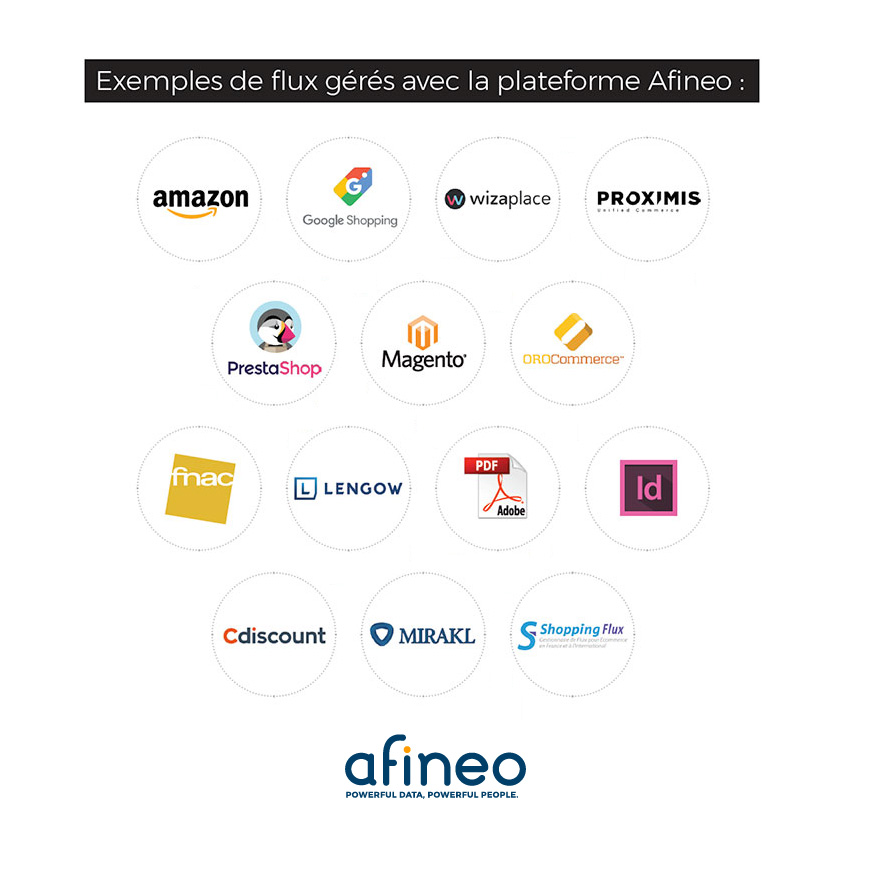
This image illustrates the interdependence of PIM and DAM in making it easier to syndicate all product data:
Unanimous approval from business users and the CIO
Users appreciate the tool and gain in productivity thanks to an intuitive ergonomics and a single interface for managing PIM and DAM, which guides them and simplifies their processes and tasks. Each user also works from a view system (a dynamic tree) that gives them the comfort of personalizing their display according to their business needs at any given moment.
For their part, the CIO gains peace of mind: by not multiplying business tools, they make sure PIM and DAM interoperate perfectly. Gone is the stress of “will this work?” and the wrath of the finance director faced with potential extra development costs: the Afineo platform carries every essential business module, including the PIM and DAM solutions.
The chief information officer also finds user rights easier to manage and saves themselves security and maintenance problems, because 100% of users are on the latest version of the software.
The companies that use PIM and DAM to become more competitive
Let us look in general terms at which organizations use these two tools together. Then let us see how and why certain companies in particular use the combination of Afineo’s PIM and DAM solutions through a few use cases.
Types of company
Every company that manufactures, buys, sells and distributes products needs to equip itself with a DAM and a PIM in order to control the syndication of product information and the related assets:
- organizations operating nationally, across Europe or internationally,
- manufacturers, industrial companies, producers and brands,
- distributors, retailers, mass-market players and distribution networks,
- e-merchants,
- wholesalers, retailers and buying groups.
DISTRI CLUB MEDICAL
A retail and e-commerce player with our best interests at heart:
- Activity: sale and rental of medical equipment to private individuals and professionals.
- Channels for syndicating the product offer: 90 points of sale, an e-commerce site, B2C and B2B e-catalogs and printed catalogs.
Why DISTRI CLUB MEDICAL chose the Afineo PIM and DAM solutions:
- Tired of a PIM solution that imposed limits and held back product listing, DISTRI CLUB MEDICAL opted for the Afineo PIM and DAM solutions, offering a complete, scalable technology in the face of the growing pile of regulations and obligations.
- The DAM natively built into the PIM brings peace of mind in use, shown in particular by a wealth of features and absolute compatibility.
The DISTRI CLUB MEDICAL teams are aiming for a responsiveness never reached before in managing and simultaneously syndicating product information and multimedia files (logos, packshots and so on) across their online and offline sales channels.
Lafuma Mobilier
A digitalized French manufacturer cultivating attractive product quality:
- Activity: manufacturer of outdoor furniture, selling to private individuals and professionals, and to partner reseller distributors.
- Channels for syndicating the product offer: e-commerce site, digital catalogs, B2B portal for partner distributors.
Why Lafuma Mobilier chose the Afineo PIM and DAM solutions:
- A single PIM/DAM interface makes it easier to classify product information and data and make it reliable.
- Data exports and imports require no complex development and are made easier by numerous connectors.
The Lafuma Mobilier teams benefit from complete fluidity when exchanging product data, internally as well as externally with their B2B customers.
Groupe TIVOLY
A manufacturer leading its niche:
- Activity: manufacturer and seller of cutting tools and power tool accessories, aimed at professionals, tradespeople and private individuals.
- Channels for syndicating the product offer: e-commerce site, e-catalogs, B2B and consumer catalogs, brochures, B2B planograms and more.
Why the Tivoly group chose the Afineo PIM and DAM solutions:
- The native PIM/DAM interconnection makes it easy to link product information and the related digital assets (photos, packshots and so on) well before syndication
- The offer can be syndicated in a way adapted to the context and the sales channel, thanks to personalization or enrichment of the “information and assets” pairing.
- The PIM and DAM solutions make it possible to put sophisticated business processes in place.
The Tivoly team benefits from great flexibility and from an independence that boosts its productivity: attributes are easy to adjust, exports and imports are varied and smooth, and syndication across communication and sales channels is intelligent.
Agapes Restauration
Food service and its multi-domain menu:
- Activity: restaurant group with multiple brands such as 3Brasseurs, Salad&Co, Il Ristorante and Flunch.
- Channels for centralizing the product offer: a B2B portal to centralize the data domains of suppliers, wholesalers and distributors
- Channels for syndicating the product offer (starters, main courses, desserts): a data domain accessible to the restaurants.
Why Agapes Restauration chose the Afineo PIM and DAM solutions:
- The Supplier Portal gives each commercial partner dedicated access, which speeds up the listing of every product, the composition of dishes, menus and so on.
- The PIM and DAM features make it possible to enrich the quality and completeness of product and supplier records, while building in regulatory constraints (traceability, production origins, traces of allergens and so on).
As both designer and distributor of meals, restaurant brands rely on PIM, DAM and MDM technologies to master a data quality that has to be flawless for foodstuffs, which are perishable. The time saved makes it possible to optimize stock and the profitability of dishes.
Manufacturers and distributors using the FAB-DIS format
In certain sectors such as air conditioning, plumbing and lighting, manufacturers and distributors prefer to send and receive their product data in the FAB-DIS exchange format.
The limits: this format is standardized as a normalized Excel file. Filling it in by hand is therefore time-consuming and prone to many errors, since the nomenclature to be respected and the coding of the reference tables turn out to be complex to master.
Afineo’s PIM and DAM solutions remove these difficulties thanks to the FAB-DIS connector. The matrix and the codings are built in so that data modelling, and the import and export of FAB-DIS files, are made easier and automated, with no risk of error.
FAQ: your questions on PIM and DAM
What is the main difference between PIM and DAM?
The PIM manages the text information about products: descriptions, prices, characteristics, technical data. The DAM manages the multimedia files: photos, videos, logos, PDF documents.
In short: the PIM answers “What am I selling?”, the DAM answers “How do I show it?”. The two are complementary.
When do I really need both a PIM AND a DAM?
You need both if:
- You sell across several channels (website + marketplaces + stores)
- You manage more than 500 products
- You launch new products regularly
- Your teams lose time looking for information or photos
- You notice frequent errors on your product records
A concrete example: you sell chairs. The PIM stores (dimensions, weight, materials, price). The DAM stores (product photo, lifestyle photo, assembly video, PDF manual). Together, they automatically create your product records across every channel.
What do I risk if I have no PIM or DAM?
The common problems:
❌ Costly errors: a different price on your site and on Amazon → unhappy customers and refunds
❌ Wasted time: your teams spend 7 hours a week looking for information or photos
❌ Lost sales: an incomplete product record, or one with a poor photo, loses 85% of its chances of being bought
❌ Slowness: it takes 3 weeks to launch a new product instead of 5 days
❌ Legal risks: missing mandatory information → fines of up to €15,000
In figures: for an SME of 50 people, “data chaos” costs around €165,000 a year in wasted time and missed opportunities.
How do I choose the right PIM/DAM solution?
The 5 essential criteria:
- Do the PIM and the DAM communicate natively? → If they are two separate pieces of software, you will have problems
- Are there connectors for your tools? → Check: your e-commerce site, your marketplaces, your ERP
- Is it easy to use? → Have your teams test it. If it is complicated, nobody will use it
- Is it scalable? → Prefer SaaS (cloud) over software you have to install
- What support comes with it? → Training, support, a dedicated project manager?
Tip: ask for a demo and test it with 10 of your real products. You will see straight away whether it works.
How much does a PIM and DAM solution cost?
Indicative ranges*:
*depending on the publisher, the size of the project, the number of users and so on.
| Solution | Average annual price |
| PIM alone | €15,000 to €150,000 |
| DAM alone | €10,000 to €80,000 |
| Integrated PIM + DAM | €25,000 to €200,000 |
But be aware: the ROI comes quickly.
→ Return on investment in 8 to 12 months thanks to productivity gains
How long does it take to put PIM and DAM in place?
Average timeline: 4 to 6 months
Breakdown of the stages over 4 months:
- Weeks 1-4: audit and preparation of your data
- Weeks 5-8: configuration of the solution
- Weeks 9-10: training your teams
- Weeks 11-12: go-live
With Afineo (a SaaS solution): it is faster than a solution installed on your own servers
Can you use a PIM without a DAM (or the other way around)?
Technically yes, but it is not recommended.
With a PIM alone: → you manage your photos in separate folders, and it is a mess
With a DAM alone: → you cannot automatically attach the right photos to the right products
The ideal: a solution where PIM and DAM are natively interconnected (like Afineo). Information and photos talk to each other automatically.
PIM/DAM: for what size of company?
This applies to you if:
- You have more than 10 people working on product data and assets
- You sell more than 500 products
- You make more than €50,000 in e-commerce revenue a month
- You sell across 2 channels or more
In short: as soon as you feel management is getting complicated, it is time.
Which PIM and DAM solutions should you choose?
Afineo’s SaaS PIM and DAM solutions also stand out with many companies that use them, such as JouéClub, Baron Philippe de Rothschild, Groupe Alliance Marine, BUT, Caran d’Ache, Glisshop, Millet Mountain Group and many more.
The reasons?
- The interconnection between the PIM and DAM solutions within a single interface.
- The modularity of the platform.
- Tailored support built on a wealth of field experience.
- Everything explained above.
Opportunity study, configuration, integration, training, evolution: our team of data and media management experts show a professional empathy suited to your context and your business challenges.
The objectives: to let you adopt both new, high-performing tools and a new, more efficient way of working.
Would you like to improve your performance? Contact us to request a demo of the platform and judge the possibilities for yourself.
💡 New to the subject? Read our complete guide: What is a PIM?

Grégory Coste
Consultant en marketing digital SaaS, il accompagne Afineo dans la création de contenus clairs et pédagogiques pour valoriser les solutions PIM, DAM et MDM. Sa mission : rendre simples et accessibles des sujets complexes.
 Afineo, a key player in reference data management, offers a SaaS MDM, PIM and DAM platform to support the digital transformation of businesses. Our multi-domain cloud solutions make data management and data quality easier, while ensuring smooth integration with your digital ecosystem.
