Implementing a DAM: 7 unmistakable signals
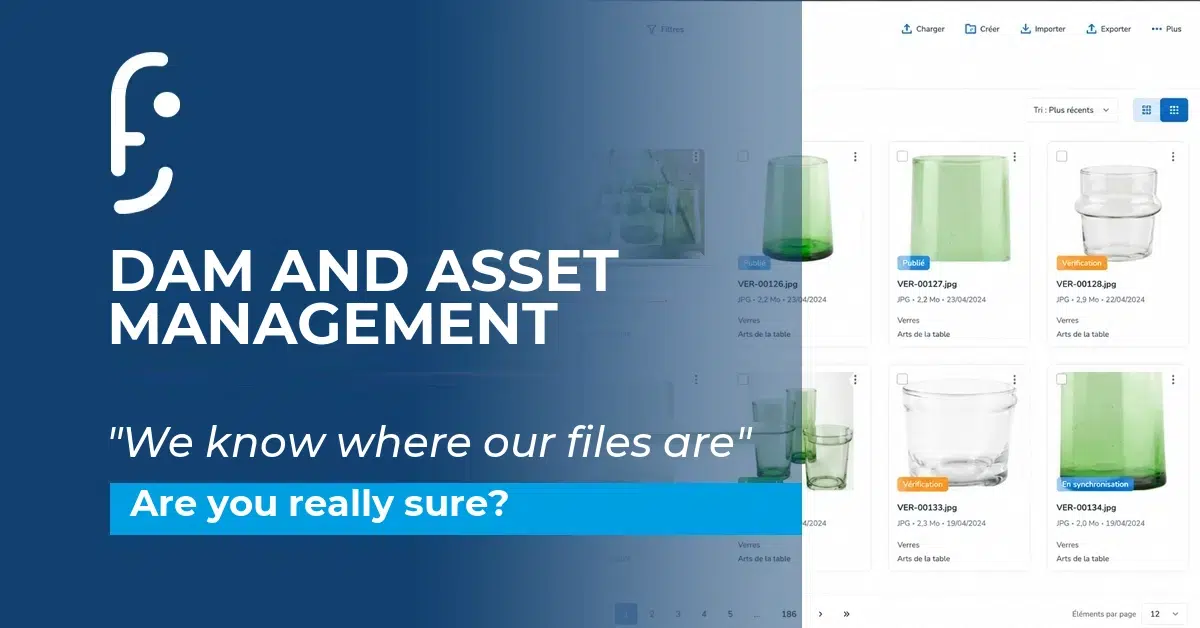
“Everyone knows where the files are.”
Until the day the campaign starts and nobody can find the right version.
You manage catalogs of several hundred items, sometimes several thousand. Every day, your teams handle product photos, packshots, technical datasheets, demo videos and marketing visuals. And yet something is stuck.
Not necessarily in a dramatic way. Sometimes it is just friction. An unnecessary delay. A version that goes out on the wrong channel. An approval that drags on. A photo nobody is sure is still cleared for use.
Here are 7 of them that we regularly encounter among the distributors, retailers and e-tailers we work with.
Key takeaways:
- Assets scattered across emails, drives and hard disks waste your teams valuable time and lead to publishing errors.
- A brand image that varies from one channel to the next erodes trust and damages the product experience.
- The absence of any tracking of rights and validity dates, including on approval documents, leaves you legally exposed.
- Manual asset processing, cropping and background removal first among them, slows your time-to-market.
- A modern DAM automates these tasks and industrializes the production of commercial visuals.
1. Your teams spend too much time finding the right file
The summer campaign starts in ten days. A product manager is looking for the updated HD packshot of a flagship item. They ask marketing. Marketing points to the studio. The studio has three versions of the file. Which one is right?
Repeated dozens of times a week across the organization, this scenario represents a real cost in time, in frustration and sometimes in publishing errors.
An outdated image published on the website or sent to a partner, meaning a degraded product experience and a risk of complaint.
A single central library, accessible in seconds. The friction is removed at source.
2. Your brand image varies from one channel to the next
On your e-commerce site, the logo is high definition. On the marketplace, it is compressed. In the print catalog, it is an older version. At one of your distributors, it is yet another variant.
In an omnichannel context, where your products appear across many touchpoints, visual consistency is a pillar of your brand image. It cannot rest on the individual vigilance of every employee or partner.
What a well-configured DAM guaranteesEvery recipient accesses the approved version, in the format suited to their use, with no risk of drift and wherever they sit in the distribution chain.
3. Rights management on your visuals leaves you legally exposed
You signed a contract with a photographer or an agency. The rights cover a limited period, a defined use, a specific territory. But who, in your organization, actually tracks those deadlines?
Without an alerting and traceability system, it is easy to keep publishing a visual whose rights have expired. Or to use a photo in a context the contract never covered. The consequences can range from a formal notice to costly legal proceedings.
This risk is not limited to photo rights. It also concerns every regulatory document attached to your products. Certificates of conformity, supplier approval letters, authorizations to sell on a given market: these documents have a shelf life. They have to be renewed. And their expiry can block a launch, trigger a product recall or expose you to liability towards your partners.
Without centralized tracking, these documents end up in an email, in a local folder, or nowhere to be found. The product stays on sale. The approval letter expired months ago.
A DAM lets you attach these documents directly to the product items concerned, with configured expiry dates and automatic alerts ahead of each deadline.
4. Collecting supplier assets is a chronic mess
Emails, WeTransfer, shared drives, USB sticks handed over at trade shows: every supplier has its own way of working, its own naming conventions, its own formats. The result: your teams spend considerable time receiving, sorting, renaming and converting these files before they can even be used.
Tracing where assets came from, essential for rights as much as for quality, is close to impossible to guarantee in that context.
Scattered intake, manual sorting, renaming, conversion. Tracing the origin is impossible to guarantee.
A connected supplier portal structures collection at source. Assets arrive qualified, named to your standards and attached to the right products.
5. Your asset approvals slow down your go-to-market
A new product is created. The data is ready in the PIM. But the visuals are still waiting for design approval, then legal approval for mandatory statements, then a final read by marketing management.
Without a formalized approval circuit, every step relies on informal exchanges. Follow-up emails. Uncertain statuses. Versions crossing each other. The product is ready to sell. It still cannot go live.
Every step is traced, the people responsible are notified automatically and lead times become measurable. On a catalog time-to-market, that gain can be counted in days.
6. Your distributors struggle to access your resources
Your distribution partners need your assets to list and showcase your products in their own environments. If that handover is laborious, if lead times are too long, if the formats do not match their technical constraints, it is your presence on their channels that suffers.
Every request lands on your teams. Formats do not fit. Lead times stretch out.
Self-service access to approved resources, in the formats suited to each use.
7. Your teams process assets by hand, one task at a time
Cropping an image for the website, resizing it for the marketplace, removing the background for the catalog, checking it complies with brand guidelines, tagging it with the right keywords for SEO: taken on its own, each of these operations looks trivial.
Multiplied by several hundred visuals every new season, it becomes a time sink and a source of errors.
Without automation, these tasks rest entirely on your teams. Every manipulation is manual, every check is human, every oversight is possible.
A modern DAM handles these operations at scale, in batches:
Automatic background removal. The background is stripped and replaced by a professional white background across your whole media library, in a single operation.
Smart cropping. A crop centred on the subject automatically produces every visual in the expected ratios, from square to landscape, depending on the target channel.
Image recognition. Visuals are scanned to automatically extract descriptions, categories and metadata. Indexing becomes immediate and feeds internal search as well as product SEO.
Variant generation. A single source visual is adapted to each channel, web, print or marketplace, with a change of background or of ambient context.
Visual compliance checking. Every image is checked automatically against your specifications: white background, centring, resolution, framing, absence of watermark. Quality control becomes systematic, rather than a random manual check.
On the Afineo platform, these operations are handled by the AI Batch in NEO AI, which industrializes the production of commercial visuals at scale. What your teams used to do image by image now runs on an entire product line from a single instruction. This building block sits squarely within the Afineo DAM solution.
Anything that rests on human vigilance eventually produces gaps. Anything automated stays consistent, visual after visual, season after season.
What these situations have in common
In each of these cases, the problem is not a lack of content. It is the lack of a structure to manage, qualify, distribute and protect it.
PIM and DAM: complementary by natureWhen the DAM is natively integrated with a PIM, the benefits compound. Product data and assets evolve together, consistent and accessible from a single point, ready to be syndicated to all your channels.
Discover the differences and synergies between PIM and DAM →
The Afineo DAM solution
Natively integrated into the Afineo platform, the DAM shares the same data model as the PIM and the MDM. Your assets are attached directly to your product records, subject to the same approval workflows and ready to be syndicated to all your channels from a single point.
Supplier portal, distributor portal, rights management, usage traceability: every signal identified in this article has a concrete answer in the platform.
Want to see in concrete terms how an integrated DAM answers these challenges on your own catalog?
Ready to structure the management of your assets?
Discover the Afineo DAM solution in real conditions, on your catalog, with your workflows, in your platform.
When should you move from a media library to a DAM?
A media library is enough as long as your assets are few and few people access them. Moving to a DAM becomes necessary as soon as files are scattered across several tools, as soon as searching wastes time, as soon as rights or regulatory documents have to be tracked over time, or as soon as visual production has to be handled at scale.
How long does it take to implement a DAM?
The timescale depends on the volume of assets to be loaded, the number of distribution channels and the level of automation you want. With a no-code platform such as Afineo, an initial rollout is counted in weeks rather than months. Structuring the media library and training the teams are the two factors that weigh most on the schedule.
Is a DAM worth it for a mid-sized company?
Yes, as soon as managing assets represents a significant workload or a risk. The return on investment comes from the time saved searching for and processing files, from fewer publishing errors, from rights kept under control and from a faster time-to-market. A mid-sized company with a catalog of several hundred items generally reaches its break-even point quickly.
Should you start with a PIM or a DAM?
It depends on your main pain point. If the problem is primarily product information, its consistency and its syndication, the PIM comes first. If the problem is assets, their dispersion and their processing, the DAM does. With Afineo the question matters less, because the PIM and the DAM are natively integrated in a single platform and can be activated together or step by step.
Can the AI Batch process thousands of visuals automatically?
Yes. The NEO AI AI Batch processes assets in bulk across the whole media library: automatic background removal and white background, smart cropping, image recognition with metadata extraction, per-channel variant generation and visual compliance checking. What used to be done image by image now runs on an entire product line in a single operation.

Armelle Allegret
Co-fondatrice d’Afineo, 25 ans d’expertise marketing au service des entreprises pour transformer leur gestion de l'information produit (PIM, DAM, MDM) en avantage concurrentiel.
Son obsession : des contenus produits clairs, fiables et efficaces.


 Afineo, a key player in reference data management, offers a SaaS MDM, PIM and DAM platform to support the digital transformation of businesses. Our multi-domain cloud solutions make data management and data quality easier, while ensuring smooth integration with your digital ecosystem.
