PIM Manager, Product Information Manager or PIM project manager? 3 experts share their views on these complementary roles
PIM Manager, Product Information Manager, PIM project manager, PIM consultant, product database administrator: who does what? English terms mix in with French ones, and it is easy to lose the thread.
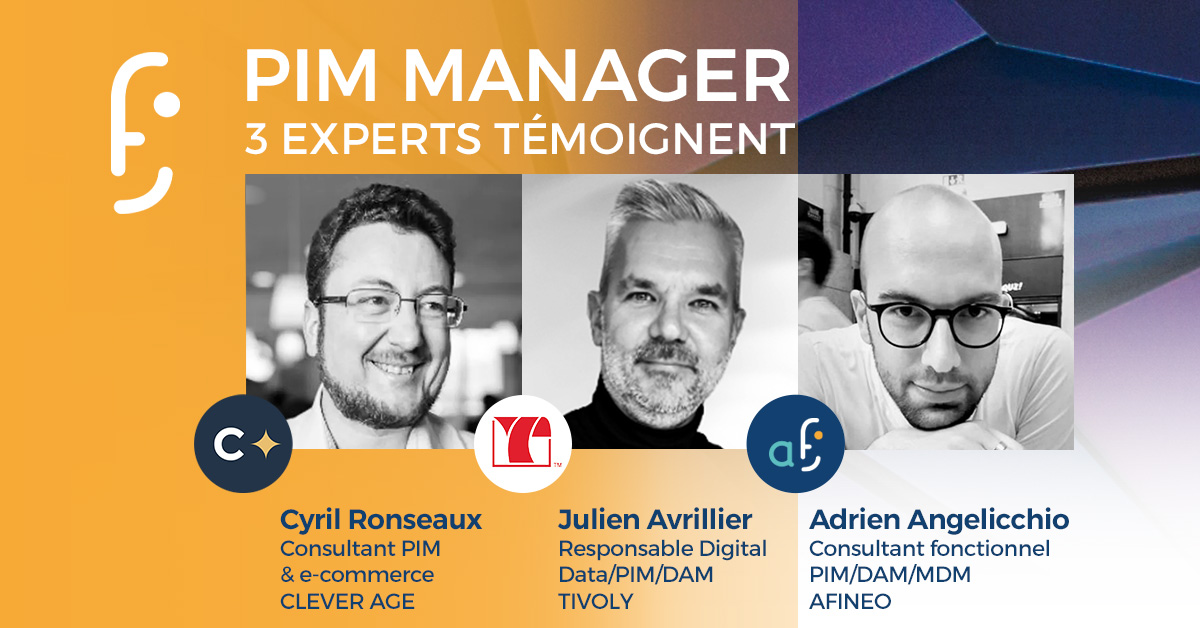
To give you a structured, clear view of the roles and responsibilities behind each job, we decided to hand the floor to each of the parties involved in product data management:
- To bring you feedback from the user side of the PIM solution, Julien Avrillier, Digital Data, PIM (Product Information Management) and DAM (Digital Asset Management) manager at Tivoly, answered our call.
- To put across the technology integrator’s point of view, we gathered the account of Cyril Ronseaux, PIM & e-commerce consultant at Clever Age.
- For an informed view from the platform publisher side, we interviewed Adrien Angelicchio, functional consultant for PIM, DAM and MDM (Master Data Management) at Afineo.
These 3 expert opinions are valuable for framing your PIM project: read them closely.
Refer to our PIM user guide to go further.
Product Information Manager on the user side: the pilot inside the company
Here is the account of Julien Avrillier, Digital Data, PIM and DAM manager at Tivoly, in interview form.

What is a PIM manager inside a company?
For my part, the scope goes well beyond the PIM. That is precisely why I personally love this role, which combines communication, marketing and IT. The PIM manager is the reference point for Marketing data, which will then be used across different communication channels.
The PIM manager has to make the tool “accessible” and “practical” for the marketing team: nobody likes “filling in databases”, but if you manage to highlight all the benefits that follow, you have won.
What are your main missions and the objectives you have to reach?
I have to make sure that every product manager can pass on all the specifics of a new product to users, through the various sales channels. Both in quantity and in quality.
To get there, the work starts as early as the design of the PIM, its structure, its attributes. In my view, you have to be able to look quite far downstream, at the final uses of the data, in order to design upstream a PIM “that will fit everywhere”. That takes listening and several rounds of back-and-forth on the modelling, but it is the key to success.
For example, if in your e-shop or e-catalog you want specific facets for sorting or choosing the right item (“How does the user choose their tool?”), you have to work that out and put it in the PIM. You easily reach 500 attributes, so be careful.
Then you can also work on the “web writing” or “SEO” parts, to guarantee quality text in your PIM, calibrated where necessary, through content length limiters or drop-down lists of pre-filled properties.
Finally, since the digital ecosystem and marketing needs are constantly changing, you have to keep contributing to the evolution of your tool to meet expectations. Integrating CSR data, new attributes, exports in new customer formats, and so on.
It is a job where you never get bored.
The objective is to guarantee that information flows smoothly and stays intact.
Why do people call on you, what makes you essential in relation to the company’s challenges?
The major challenge, in my view, is the integrity and availability of marketing data.
At the other end of the PIM there are “the consumers”, in particular through Google and its “micro-moments”: TO BE THERE, TO BE USEFUL, TO BE QUICK. Information has to be accessible immediately, anywhere, any time, and above all of good quality.
Upstream, the PIM Manager handles maintenance, supports the product managers, and keeps developing the PIM so it fits new needs as well as export formats. Producing rich content for a new product takes time, but once it is in the PIM/DAM, the marketing work is ready to be syndicated, automatically.
Downstream, the PIM manager builds the path and guides the data into the various channels such as e-catalogs, price lists and catalogs (with Easycatalog), but also to our distributor customers through exports.
So it is a very broad spectrum, which starts with pulling data out of the ERP, enrichment in the PIM, and goes all the way to our customers’ databases.
How do you become a PIM manager, do you have to follow a specific course?
It is more a matter of “sensibility” than of training.
I started my working life on the statistics and database side of marketing, designing, creating and producing specific price lists and catalogs. So, like many people, I suffered quite a lot from having to work on heavy Excel files in shared mode, with all the trouble that comes with it.
If you like structuring information, training people to use its modelling and passing information on, then I think you have everything you need to be a “PIM Manager”.
It is important to put in place regular support for the marketing teams (training, tutorials, wiki and so on), along with workshops for the continuous enrichment of data (in particular the search for products’ Unique Selling Value to differentiate them). All of this creates momentum and reassurance, and makes the PIM tool accessible and indispensable for internal teams.
In 2017 I even made “Integrating a PIM into the company as the cornerstone of digitalization” the subject of my dissertation and defence, when I went back to study and obtained a Web Marketing Project Manager qualification (a course in which, incidentally, not one of the 25 modules mentioned PIM or DAM).
So you could say I trained myself, or almost, with the indispensable help of Pascale and Adrien on the Afineo side. The availability of the Afineo team is genuinely essential for getting to grips with your PIM and modelling it properly.
What career paths are possible?
Data is more than ever at the heart of marketing and commercial success today. I have the feeling that the PIM manager is a link between IT and Marketing. So career paths would be on 3 levels in my view. More on the IT side, if you are fonder of the technical part.
Otherwise, on the Marketing side, if you favour the “functional” part of using the PIM, in particular on the PLM (Product Lifecycle Management) side.
And finally, by changing company every 5 years to support the birth and rollout of the PIM from A to Z, in the many companies that choose to adopt this tool, more of them every year.
What are the opportunities for finding a job as a PIM Manager?
As I said earlier, the PIM is becoming an indispensable tool today. Even a commercial asset, for distributors who are guaranteed to have data, quickly, and of good quality.
So it is a “new” job, with no real formal training that I know of: for anyone who has “managed a PIM project”, I imagine this role will be more and more sought after.
Is there one point or feature you want to stress?
Afineo is a combined PIM and DAM solution that is very practical for data and asset interconnections. The PIM therefore offers a great deal of freedom for development, adjusting attributes, varied exports, statistics, data exports and imports, without needing to be a developer.
For a mixed Marketing/Communication and Business/Data Analyst profile like mine, it is ideal.
Being able to pull the data out into Excel very easily (and reimport it) is certainly the feature I prefer in the Afineo PIM solution.
It lets product managers proofread, enrich and correct their data very easily through Excel, a tool everyone knows well today.

The PIM consultant at the solution integrator
Here is the account of Cyril Ronseaux, PIM & e-commerce consultant at Clever Age, in interview form.

What is a PIM consultant at a software integrator?
A PIM consultant can step in at two levels:
- In pre-sales or upstream, in order to select the PIM solution best suited to the client’s needs and budget.
- During the rollout phase, to guide the client and the delivery teams toward the most effective and best-suited implementation possible.
What are their main missions and the objectives to reach?
The consultant’s main mission is to understand the client’s needs and way of working, then to propose an implementation in the PIM solution that has been selected.
That means:
- Running workshops with the client’s key users and infrastructure teams,
- Modelling the products and objects carried by the PIM (brands, product lines, suppliers, assets and so on),
- Specifying the human and automated processes that allow PIM data to be contributed and used,
- Defining the interface contracts for the flows that feed and syndicate the data.
The PIM is a productivity tool, it has to save users time, and that is an important point the PIM consultant must keep in mind and use when rolling the tool out.
Why call on them, what makes them essential in relation to the client’s challenges?
In general, a client knows their products and their data well, but it is not obvious for their teams to project their needs into the software. The PIM consultant takes a step back and brings their expertise so the right choices get made.
The PIM consultant is crucial for a company rolling out its first PIM. Backed by several implementations at other clients, they make proposals, share good practice and flag risks and complexities.
Compared with someone working for the publisher, a PIM consultant at an integrator often has a wider, more varied portfolio of PIM projects behind them. They can reassure the client about the choice of solution, and even help the publisher develop its platform to meet a client need without resorting to specific developments that are expensive to maintain.
How do you become a PIM consultant, do you have to take a course?
Becoming a PIM consultant requires solid practice with one or more PIM tools. That can come from implementation work at a PIM publisher, at an integrator, or as a PIM user at a client.
Good e-commerce knowledge is a real plus (the PIM is generally used by marketing teams to feed sales spaces), but experience with other data and process management tools (ERP, CRM, PLM) helps too.
The roles of functional project manager, systems engineer and business analyst can quickly shift toward the PIM consultant role.
There is no empirical course for becoming a PIM consultant. You have to be comfortable with clients, know how to take a step back, have a certain capacity for abstraction, be able to work independently and have good analytical skills. Courses in data modelling, process modelling and data flows are a good way in to this job.
The tools to master (besides PIM solutions) are documentation and collaboration tools (e.g. Confluence), presentation software (Slides, PowerPoint and so on), Excel (unfortunately, even today, this spreadsheet is popular for exchanging data between people, such as product teams and suppliers) and above all your web browser (most PIMs these days are driven through web screens).
What career paths are possible?
A PIM consultant can move into project management or project direction (at a client, at the integrator, or even with a PIM publisher), into pre-sales or into sales. They can also become an e-commerce consultant (on platforms such as Magento, Prestashop, OroCommerce and others) or move toward data governance, performance analysis and other roles around product data.
What are the opportunities for finding a job?
PIMs are booming, many companies want to equip themselves and integrators are looking for PIM consultants to strengthen their teams.
The PIM project manager at the software publisher
Here is the account of Adrien Angelicchio, functional consultant for PIM, DAM and MDM at the SaaS software publisher Afineo, in interview form.

What is a PIM project manager at a software publisher?
The specifics of the role are particular to each organization. In any case, at Afineo you have to be a jack of all trades and have a good technical streak to really thrive in this role.
You often end up wearing several hats:
- Marketing & sales, to “sell” the solution, that is, to convince.
- Project manager and business project support: win the project and onboard the client.
- Product owner: being involved in the evolution of the solution itself, as well as being its first user. So I give the first feedback, report bugs and test new features.
Let us not forget the advisory oversight side either: keeping an eye on budgets, licences and so on.
We also work with external integrators, and then wear a “technical support” hat. That does not mean we drop the project follow-up, since we make a point of reviewing the specifications and taking part in writing them, mostly on the technical aspects.
We obviously make sure good practice is respected and keep challenging the client (which this time is the integrator). And they will not hold back from challenging us in return. It works both ways.
What are their main missions and the objectives to reach?
The main objective is client satisfaction.
The main mission is to manage and support the client’s journey from A to Z:
- By taking part in pre-sales to pin down and frame the prospect’s needs, sometimes going as far as setting up a POC (proof of concept).
- By handling the demos given to the various contacts on the client side, who generally split between IT on one side, and marketing, product managers and data managers on the other.
- By contributing to drawing up the requirements specification when there is none, in order to frame the project scope.
- By estimating the production effort involved in the integration, along with the features to include in the licence.
Once the project is won, it is time to fully onboard this new client:
- By initiating the kick-off meeting.
- By organizing the framing workshops, taking part in the steering committee and the project committee.
- By planning and delivering the training that lets the client use the tool fully and independently.
- By carrying out the implementations and configuration.
- By staying in touch with our development teams, for everything to do with client change requests.
- By overseeing the go-live: handling support and third-party application maintenance throughout the life of the project, launching new development work if needed, monitoring budgets.
Obviously, there is everything to do with the internal Afineo scope:
- Taking part in brainstorming on how the solution and our roadmap evolve.
- Submitting change requests for my own needs as an integrator.
- Testing new features.
- Producing documentation for clients.
Why call on you, what makes you essential in relation to the client’s challenges?
First of all because I have cross-cutting expertise in the solution:
- So I can choose the right functional building blocks to meet the client’s needs.
- I develop the solution to cover specific use cases that are not covered, or are hard to cover.
- I can anticipate the technical pitfalls to avoid, and therefore the loss of time and money on the client side.
Then because I have extensive experience and command of business and end-user needs. That lets me:
- Challenge the client’s current processes and reinvent them around what the solution makes possible.
- Point out inconsistencies that make day-to-day data management heavy going.
In every case, I have to be able to get past potential resistance on the client side: helping people overcome the blocks that come from habit or fear of the new.
On that note, let me take the chance to say that proper onboarding is never a luxury.
How do you become a PIM project manager, do you have to follow a specific course?
As far as I am concerned: the school of life.
I took a scientific course and started getting interested in data management on my own, to meet needs in the scientific laboratory sector.
They too are far too often at the age of the individual, scattered Excel file, which is expensive in every respect. An Excel file in a laboratory holds data on a project running over several years with very substantial budgets.
The stakes are different, but just as strategic: no company can afford to lose time, and therefore money, finding and using its own data.
What career paths are possible?
PIM architect, Data Manager or Data analyst in companies; functional data consultant, expert in business process management, functional expert and so on.
What are the opportunities for finding a job?
The networks of clients and partner integrators, and LinkedIn too.
Both the job and the subject in general are more and more sought after, because they are more and more critical and indispensable in companies and organizations.
Is there one point you want to stress?
Never guess, always spell things out.
PIM Manager: no standard job description, but complementary roles
Afineo warmly thanks each of the experts for their insights.
To the question “What is a Product Information Manager?”, we can see that the meaning of a job title varies according to each person’s concerns, roles and responsibilities.
We hope you now have a clearer view of the different names given to the “PIM Manager” role.
These names all belong to the management of product information and related resources such as photos, videos and multimedia files, and to syndication questions such as those concerning product records.
Reading the accounts of the three experts, we can say unanimously that a precise requirements specification and collaboration are at the heart of the success of a project to roll out a PIM solution.
👉 This article will also be of interest to you: Which PIM software should you choose for an SME?
💡 New to the subject? Read our complete guide: What is a PIM?

Grégory Coste
Consultant en marketing digital SaaS, il accompagne Afineo dans la création de contenus clairs et pédagogiques pour valoriser les solutions PIM, DAM et MDM. Sa mission : rendre simples et accessibles des sujets complexes.
 Afineo, a key player in reference data management, offers a SaaS MDM, PIM and DAM platform to support the digital transformation of businesses. Our multi-domain cloud solutions make data management and data quality easier, while ensuring smooth integration with your digital ecosystem.
