PIM comparison France 2025: an objective guide to choosing the right PIM solution
Let us be honest…
At Afineo, we publish a PIM / DAM / MDM solution. And because we know this market well, we would rather say it plainly: you will not find a “ranking of the best PIM software in France” here.
Why? Because no vendor can objectively assess its competitors without having tested their solutions in depth. It would be like comparing cars without having driven them.
At Afineo, we chose a different approach: giving you the right criteria and the right questions so that you can build your own comparison.
Our goal: helping you choose the solution best suited to your organization, your teams and your product data flows.
PIM, DAM, MDM definitions: what are the differences?
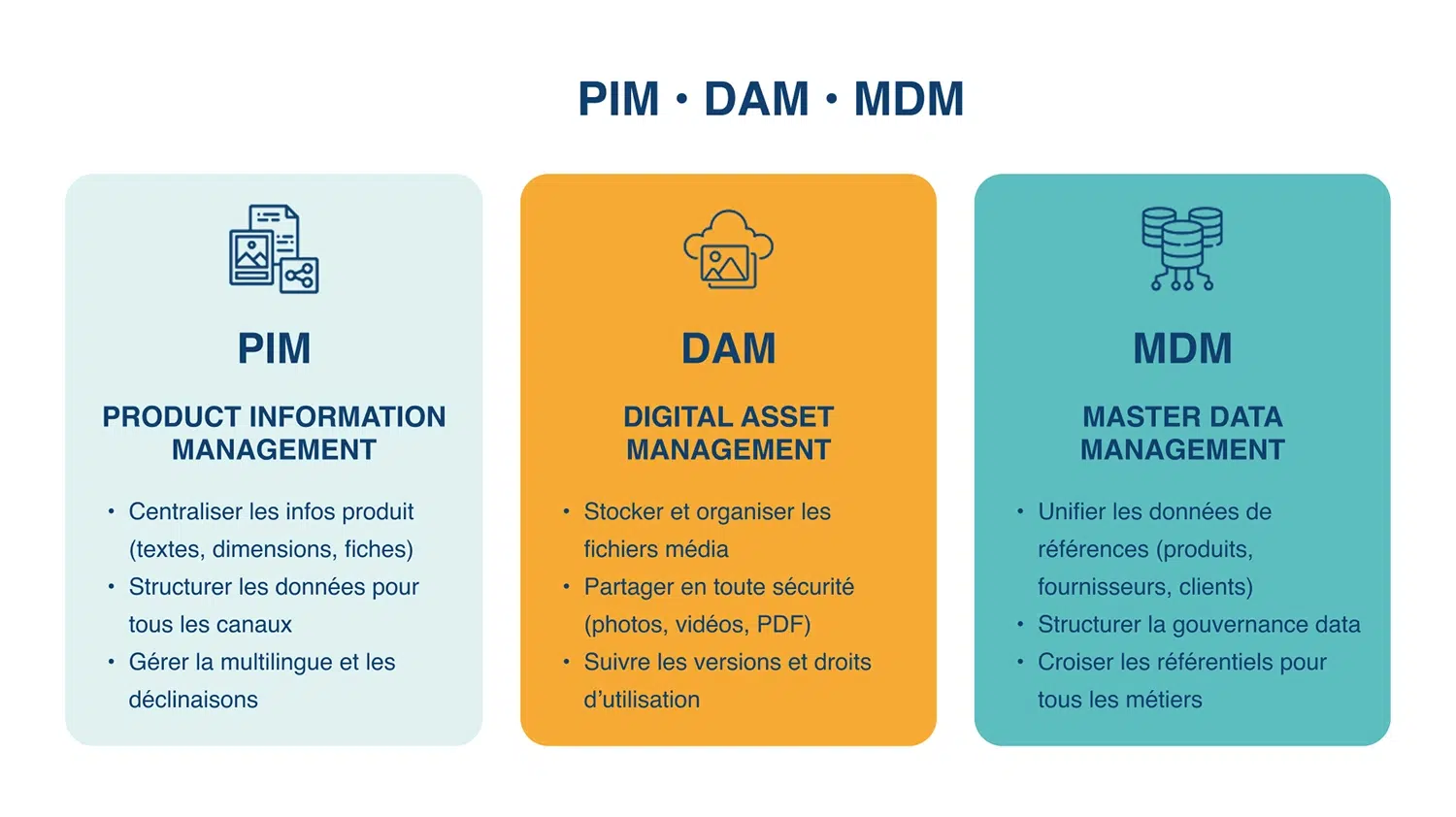
PIM – Product Information Management
A PIM lets you centralize, enrich and syndicate all the information attached to your products: descriptions, technical characteristics, visuals, variants, translations. It is the brain of product data.
To go deeper, read our complete guide to the PIM.
DAM – Digital Asset Management
A DAM manages media files: photos, videos, PDFs, technical datasheets. It makes them easier to store, find and distribute across all your channels.
MDM – Master Data Management
An MDM centralizes all reference data (products, customers, suppliers, plants). It often encompasses the PIM and the DAM within overall data governance.
Why are there so many PIM comparisons online?
The search terms “PIM comparison France” and “PIM solutions comparison” are very popular. So many vendors publish their own analyses, often based on their own experience or on a specific view of the market.
That is a good thing: it shows how lively the sector is. But it is essential to keep a critical eye and to build your own frame of reference.
At Afineo, we would rather offer an educational and methodical approach: no podiums, but useful markers for comparing solutions against your real challenges.
The main players in the French PIM market
The French PIM market is rich and varied. Here are a few vendors you will probably come across during your research:
- Akeneo – An open source player known for its modularity and its community.
- Quable – An intuitive, marketing-oriented SaaS solution.
- Pimcore – A complete, technical platform suited to complex environments.
- Map’s System – A Luxembourg specialist in the connected PIM.
- OneBase – A vendor and integrator offering a catalog and web-to-print oriented solution.
Apologies to those we have left out.
Each has its strengths and its specific character. The point is not to find “the best”, but the one that fits harmoniously into your ecosystem.
Why a genuinely objective comparison is hard to produce
A completely impartial comparison would require:
- In-depth demonstrations of every solution,
- A consistent assessment of support, documentation and flexibility,
- An identical test protocol for every company.
In other words, a full audit engagement. That is not the role of vendors: their job is to help their customers assess for themselves.
How should you compare PIM/DAM solutions in 2025?
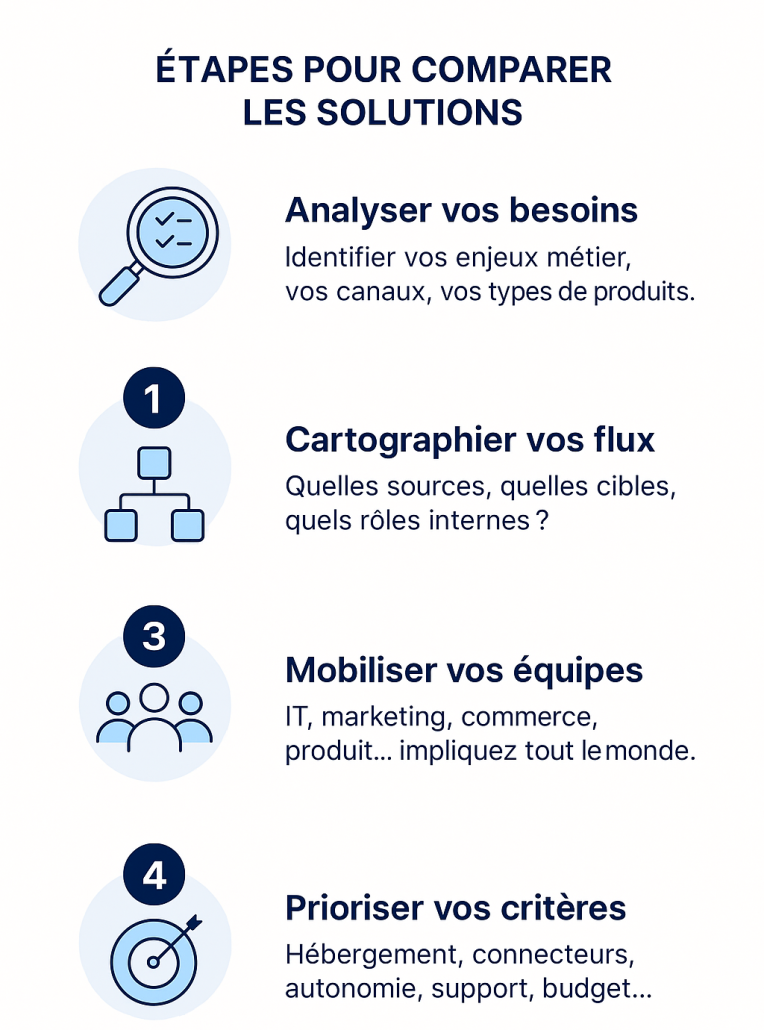
To compare PIM solutions effectively, you need a structured approach in four steps:
- Analyse your needs: retailer, manufacturer, marketplace, every business has its own priorities. A tool that suits one may be wrong for another.
- Map your flows: identify your sources (ERP, suppliers), your targets (marketplaces, CMS, partners) and the internal roles involved.
- Bring your teams on board: success depends on collaboration between IT, marketing, e-commerce, product and management.
- Prioritize your criteria: hosting, UX, connectors, support, total cost, autonomy, scalability, rank them in order of importance.

Good practice during the consultation phase
Once your needs are clear, the consultation phase is crucial for comparing solutions effectively.
- A clear specification document: concise and structured, not encyclopaedic. A few well-thought-out pages beat an indigestible file.
- A reasoned shortlist: limit your consultation to 3 to 5 vendors. Too much choice blurs the comparison.
- Tailored demos: ask each vendor to work on your real use cases, not on marketing scenarios.
Better than a comparison: the right questions to ask
A good PIM comparison is not just a list of features. To assess each solution objectively, nothing beats a set of concrete, structured questions to put to vendors during demonstrations or tenders.
These questions will let you get past the sales pitch and assess the real ability of each solution to fit into your environment and answer your challenges:
| 💬 Topic | ❓ Question to ask the vendor |
|---|---|
| Integration | How does the solution integrate with your ERP, CMS, e-commerce platform and other existing tools? |
| Customization | What scope is there to adapt the data model, the workflows or the user interface? |
| Internationalization | Does the platform handle several languages, currencies, catalogs or brands? |
| Maintenance & scalability | How are software updates handled? Can the solution grow with your organization? |
| Security & compliance | What guarantees of security, confidentiality and GDPR compliance do you offer? Where is the data hosted? |
| Team autonomy | How much autonomy will your business teams have to administer the PIM and develop it further? |
| Deployment lead times | What are the average implementation lead times for a project of a similar size to yours? |
| Support & assistance | What types of support are offered (hotline, ticketing, SLA)? What are the support hours? |
| Connectors & API | Does the solution offer native connectors or an open API to make integration with other systems easier? |
| Governance & traceability | How are access rights, traceability, change history and data approval handled? |
| Costs & ROI | What hidden costs might there be (maintenance, enhancements, additional users, storage)? How do you assess the return on investment? |
👉 By structuring your consultation around these criteria, you will get answers that are comparable, concrete and verifiable.
That is the best way to choose a PIM solution suited to your environment, without being swayed by announcement effects.
Why Afineo takes a different approach
Afineo does not set out to compare itself, but to support. Our mission: helping companies take control of their product data and build a solid, scalable information system.
- An integrated PIM + DAM + MDM solution.
- A step-by-step, supported implementation.
- A human, pragmatic approach adapted to each organization.
Before you even start comparing vendors, take the time to understand the concrete benefits a PIM can bring to your organization.
Discover our approach and put us to the test on your real needs.
FAQ – Your frequently asked questions
Is an open source PIM free?
Not necessarily. The code may be free, but hosting, integration, maintenance and support costs still have to be budgeted for.
How long does it take to deploy a PIM project?
Depending on the complexity and size of the project, deployment can take between 3 and 9 months. A solid scoping phase is often the key success factor.
Should you centralize everything (PIM, DAM, MDM) from the start?
No. It is often more effective to move forward in stages. Start with product data, then widen gradually towards the DAM or the MDM.
How do you get teams involved in a PIM project?
Involve the business teams concerned (marketing, e-commerce, product, IT) from the outset. User buy-in is what guarantees lasting adoption.
Which indicators should you track to measure the success of a PIM?
Data quality and completeness, update times, publication speed, fewer product errors and smoother exchanges between departments.
What budget should you plan for a PIM solution?
The cost depends on the scope and the model chosen (SaaS, licence, open source). It covers the licence, integration, maintenance and support. What matters is assessing the overall ROI: time saved, reliability, efficiency.
Key point: compare with method and common sense
The best PIM is not the one that tops a comparison table, but the one that meets your needs, integrates with your tools and supports your company as it grows.
In 2025, choosing a PIM is above all a collective project, centred on data and on how it is used.
Take the time to assess, to question and to test. The right choice is the one that makes managing your information simpler, more reliable and more sustainable.
📘 Want the full picture of Product Information Management? See our reference page: What is a PIM?

Armelle Allegret
Co-fondatrice d’Afineo, 25 ans d’expertise marketing au service des entreprises pour transformer leur gestion de l'information produit (PIM, DAM, MDM) en avantage concurrentiel.
Son obsession : des contenus produits clairs, fiables et efficaces.

 Afineo, a key player in reference data management, offers a SaaS MDM, PIM and DAM platform to support the digital transformation of businesses. Our multi-domain cloud solutions make data management and data quality easier, while ensuring smooth integration with your digital ecosystem.
