Making your PIM project a success through Data Literacy

Your teams use a PIM but struggle to get full value from your product data?
We help our customers build their teams skills, directly in their own PIM environment, with their own data.
Goal: improve product data quality, accelerate time-to-market and maximize the ROI of your PIM project.
You invested in a PIM (Product Information Management) software to centralize your product data and make it reliable, and that is exactly right. It is an essential step towards mastering your product domain.
And yet you may find that adoption by the teams is slow, or that the expected return on investment (PIM project ROI) is slow to materialize. The problem often lies not with the tool itself, but with the skills needed to get full value from it.
This is exactly where PIM training becomes the strategic lever that makes all the difference. More than simply learning to use a piece of software, effective training aims to build the Data Literacy of your people: their ability to understand, enrich and make the most of data quality day to day.
Unlike generic PIM training, our approach is tied directly to your project and to the concrete use of your solution.
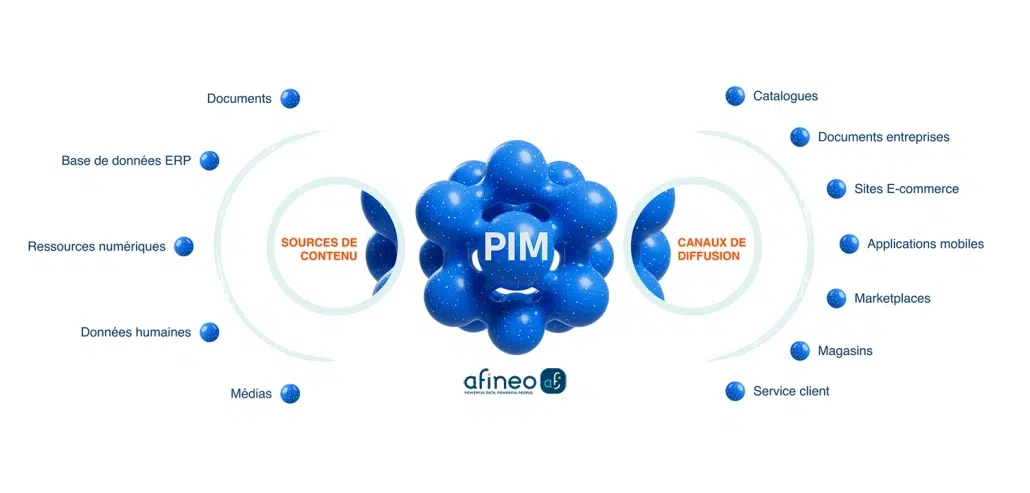
Implementation diagram of a PIM project to centralize product data.
Definition: beyond the numbers, a data culture
Data Literacy is the ability to understand, interpret and use data in order to make informed decisions.
In concrete terms, in a PIM context, that means your teams can:
– Understand the quality and completeness of product data
– Identify the key information for each channel (e-commerce, marketplace, and so on)
– Spot inconsistencies and improve the data
– Use data to steer marketing and product decisions
Being “data literate” means knowing how to interpret that information, put it in the context of real business challenges, and use it effectively. The end goal is to build the ability to make strategic decisions or spot opportunities based on tangible evidence, rather than on intuition alone.
Why should PIM training aim at Data Literacy?
Training a team on a PIM is not a matter of showing them where to click. The real goal is to make them intelligent about product information. Data Literacy, in this context, is the ability of every user to:
- Read and understand the data: interpret a completeness rate, understand the impact of a missing attribute on product records.
- Enrich intelligently: identify which product information is crucial for which sales channel (e-commerce site, marketplaces, print, and so on).
- Question and improve: spot an inconsistency in supplier data, propose an improvement to the data model.
- Communicate with data: use the PIM dashboards to justify a marketing decision, measure time to market or steer the customer experience.
A training rollout that does not build this mastery condemns the tool to remain a simple information warehouse, instead of making it an engine of performance. This is where PIM Data Literacy becomes a vital skill: it gives the teams the means to get full value from the technology investment.
A PIM without training stays underused
The absence of a structured PIM training program creates hidden costs that weigh heavily on the ROI of your project:
- Product launches delayed by a slow, inefficient enrichment process.
- Customer experience degraded by incomplete or inconsistent product records.
- Strategic decisions distorted by faulty data analysis.
- Teams losing motivation and seeing the PIM as a constraint rather than an ally.
These brakes slow growth and weaken the competitiveness of the company. A poor time to market, for example, can cost significant market share. A Forrester study confirms that data-driven companies outperform their competitors by three times in terms of growth. Reaching that level is impossible without investing in data quality and in appropriate training.
The benefits of PIM training for your teams
Investing in PIM training generates benefits well beyond simply using the tool:
- Agility and time-to-market: skilled teams drastically reduce the time needed to implement and to bring new products to market.
- Stronger collaboration: by sharing a common language and common processes around product information, silos disappear. Marketing, sales and IT work together more effectively.
- Higher data quality : users become the guardians of reliable, up-to-date information. The data is continuously enriched and approved, which limits errors.
- Employee engagement: mastering a central tool and understanding its impact is a lasting motivator. A team that feels competent and accountable is more proactive.
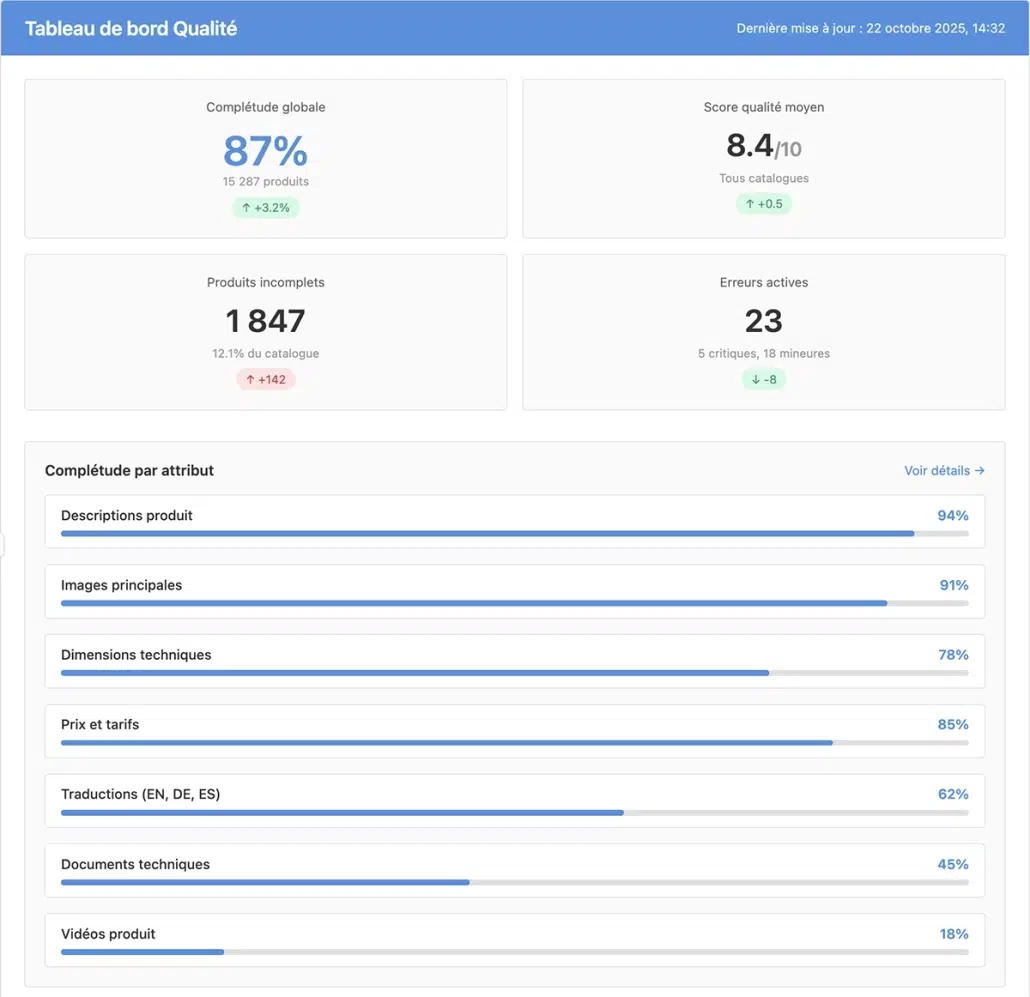
Example Afineo PIM dashboard helping teams visualize the completeness and quality of product data.
How do you build an effective PIM training program?
A successful program is a tailored program. Here are the 5 key steps:
- Assess how the tool is used and define personas : map current skills and create profiles (contributor, category manager, administrator, and so on). Each profile should get a path of its own: setup, managing product records, tracking sales channels.
- Secure management buy-in: management has to lead by example, using data to justify its decisions and celebrating the successes of the PIM project.
- Build a practical, tailored program : design workshops based on your own data and product domains. The goal: skills that can be applied straight away.
- Build on the right tools : a PIM software or an MDM/DAM solution is effective if your teams know how to use it AND how to interpret the results. Training has to cover technical mastery as well as the ability to turn data into information that supports decisions.
- Establish a culture of curiosity and measurement: encourage the teams to question the data:
-
- “Is this completeness rate enough for this sales channel?”
- “Is our product domain up to date?”
- “Does this update genuinely improve data quality?”
Rely on clear KPIs to track progress and demonstrate the impact on ROI.
A focus on data governance
The success of a PIM project also rests on solid data governance. Training the teams also means instilling the rules and good practice tied to that governance:
- Define clear roles and responsibilities (who approves what, and when?).
- Put in place approval workflows to secure the rollout.
- Make sure the data is reliable, complete and updated in real time.
Governance strengthens trust in the product domain and improves data collection from suppliers and partners. It contributes directly to the success of the PIM project and to the expected ROI.
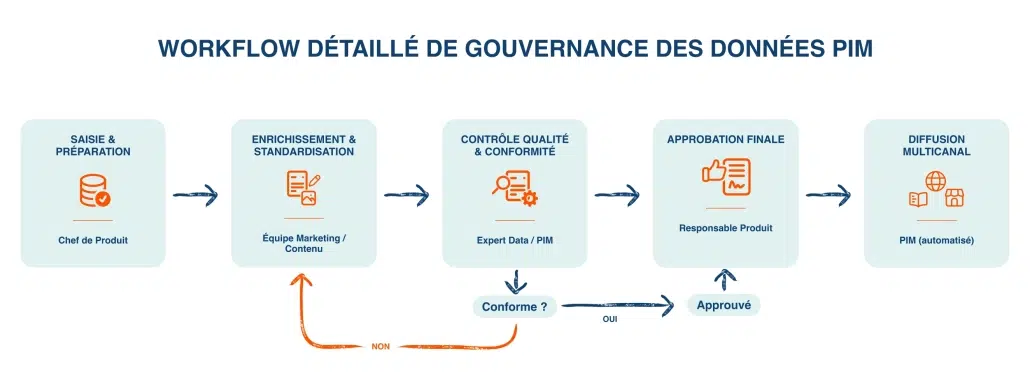
Illustration of a simple data governance workflow in a PIM project.
Expert view: Data Literacy is (above all) a business matter

To better understand the concrete stakes of Data Literacy in a PIM or MDM project, let us hand over to:
Olivier Giroud, expert in collaborative solutions and associate director of Marketing-Highways
“Beyond technical mastery of the tool, mastering the data necessarily requires a thorough knowledge of the products, of the company, of the channels used and of the business rules that make the objectives achievable.
A few simple examples help to get a better grasp of these subjects:
- What are the right arguments to highlight the advantages of this item?
- What qualities or characteristics specific to this item set it apart from the competition?
- Are these arguments, and more broadly all the texts describing my item, clear, explicit and perfectly translated (with no false friends) into the various languages used?
- Are your visuals of good quality, consistent and meaningful enough to showcase the products presented?
- If you have to manage prices or promotions, do you have all the information you need to set the thresholds or the strategy in line with company rules and with the law?
- Are you certain your products will actually be available on the promotion or leaflet date? Are the customs classifications, declarations of conformity and supply chain forecasts up to date?
These are only examples, but they show that filling in a PIM correctly is not simply a matter of putting text into cells, it takes consistency, a guiding thread and therefore a whole strategy that the teams in charge have to understand and respect.
There are many tools out there, some built into your PIM or your future PIM, so do not miss out on them. And above all, give real weight to the technical and business training your teams will need to draw the maximum benefit from your investments.
Data Literacy is not a passing fashion, it is a genuine pursuit of quality and performance in the service of your sales channels.”
For other concrete accounts of how important training and skills are in managing product information, read the views of 3 PIM experts sharing their perspective on the profession.
Training: the real fuel of your PIM
If the PIM is the engine of your product strategy, PIM training is its fuel. By building Data Literacy, you make sure the technology promise translates into concrete results: better data quality, an optimized customer experience, a faster time-to-market and better collaboration between your teams.
In other words, investing in an appropriate training program means giving your company the means to turn product information management into a genuine, lasting competitive advantage. Training is not an option, it is a condition of success if you want to get full value from Product Information Management and build a genuinely data-driven organization.
To maximize the impact of your PIM training, a tailored approach is essential. Every team has specific needs and varying levels of skill. By offering modules that fit, you let everyone progress at their own pace while improving data quality and mastery of the product domain. That fosters engagement and motivates employees to apply what they have learnt in their daily work.
It is also crucial to include case studies and concrete examples in the training sessions. This helps participants picture how the concepts translate into effective practice and a successful rollout. By sharing the successes and the challenges other companies have met, you inspire your teams to innovate and to adapt how they use the PIM software to your own context.
Finally, do not overlook the importance of follow-up after the training. Running refresher sessions or practical workshops reinforces what has been learnt and secures the success of the project. By creating an environment of continuous learning, you put your company on the path to excellence in product information management. In short, investing in PIM training means investing in the future of your company.
Ready to train your teams on the PIM?
Why train your teams with Afineo?
– Training based on your real PIM environment
– Concrete cases drawn from your own product data
– A combined business and technical approach
– Measurable results: data quality, time-to-market, ROI
FAQ – Everything about PIM training and Data Literacy
Still have questions about why Data Literacy matters, or about setting up PIM training in your company? Here are the answers to the most frequent ones.
What exactly is Data Literacy?
It is the ability to understand, handle and use data in order to make better decisions. In a PIM/MDM context, that means knowing how to interpret a completeness rate, check the consistency of a product domain or identify the impact of a product record on sales.
Who is Data Literacy training for?
Every team involved in managing product information: marketing, product managers, data managers, e-commerce, and management too. Each profile has specific needs and can follow a path that fits.
Is a good PIM/MDM tool not enough on its own?
No. On its own, a tool guarantees neither data quality nor its proper use. It is the combination of tool and human skill that delivers concrete results and improves the customer experience.
How long does it take to train the teams?
It depends on the roles and on the starting level of maturity. But in general, a few targeted workshops are enough to trigger the penny-drop moments and establish good habits. At Afineo, we offer short, concrete, operational formats to speed up the rollout.
Do you offer training built around your own tools?
Yes. We design tailored training based on your own product domains, processes and Afineo platforms. The goal: making immediate practice possible and securing the success of your PIM project.
How do you measure the success of PIM training?
Through concrete KPIs: record completeness rate, time-to-market, number of errors detected, customer satisfaction, and so on.
💡 New to the subject? Read our complete guide: What is a PIM?

Armelle Allegret
Co-fondatrice d’Afineo, 25 ans d’expertise marketing au service des entreprises pour transformer leur gestion de l'information produit (PIM, DAM, MDM) en avantage concurrentiel.
Son obsession : des contenus produits clairs, fiables et efficaces.


 Afineo, a key player in reference data management, offers a SaaS MDM, PIM and DAM platform to support the digital transformation of businesses. Our multi-domain cloud solutions make data management and data quality easier, while ensuring smooth integration with your digital ecosystem.
