FAB-DIS and PIM: automated file generation and import for manufacturers and distributors

FAB-DIS is a data exchange format between manufacturers and distributors. It is standardized as a normalized Excel file that includes a reference nomenclature. The goal: smooth the flow of product information between suppliers and resellers.
This article first explains the subject in plain terms and tells you about the structure of the FAB-DIS format. It then explains how the Afineo PIM solution lets manufacturers generate FAB-DIS files automatically and lets distributors import them in an automated way.
We also invite you to read:
- our complete guide to Product Information Management,
- our feature on use cases for combining PIM and DAM software.
What exactly is FAB-DIS?
Let’s start with the origin of the FAB-DIS format: its purpose, the problems it solves and the benefits for manufacturers and distributors.
Genesis: a collaboration between manufacturers and distributors
The FAB-DIS format came out of joint thinking by distributors and manufacturers who are members of IGNES (a trade association of industrial companies) and of the FDME (Fédération des Distributeurs de Matériel Électrique, the French federation of electrical equipment distributors).

The collaborative work carried out by these players was originally driven by the need to solve several problems:
- misunderstandings between manufacturers and distributors,
- the disparity of product data exchange formats,
- the fragility of certain IT systems and software,
- duplicate information about one and the same product,
- a set of time-consuming practices,
- the risk of circulating incorrect information,
- laborious product listing and go-to-market,
- costly consequences.
Since 2015, the FAB-DIS format has won over more than 1,300 companies: a dedicated committee now represents the trades and players who care about improving their data exchange processes.
Outcome: a standardized data exchange format
The FAB-DIS solution solves a great many issues and thereby makes data exchange between suppliers and resellers easier.
Providing a standardized file in Excel format gives every player:
- a file format that is easy to use,
- a shared structure to work with,
- reference tabs by information category,
- precise product data,
- standardized readability that rules out confusion,
- a FAB-DIS template that is free of charge.
Manufacturers therefore have an accessible way to share reliable product information that is up to date and ready for distributors to use.
Distributors can then import that information into their product domain and use it to syndicate their commercial offering.
The structure of the FAB-DIS format also makes it possible to include the mandatory statements specific to a given trade: we detail that structure below.
Note: the pre-configured Excel templates also exist in Access, but with a single tab.
Benefits for manufacturers
Goodbye to the many different data formats to send to different distributor customers!
Manufacturers share a single file format with all their resellers.
They check that their information complies by relying on a standardized template that everyone uses. They can also use the Easy-Check by FAB-DIS tool to cross-check the right correspondences.
They save time creating their data exchange files, while limiting errors and making sure compliance is respected.
They improve their business relationship with distributors: offerings are listed faster and better showcased thanks to the inclusion of product-related media (images, videos, etc.).
Benefits for distributors
No more tearing your hair out over the different logics tied to manufacturers’ trades and their technical specifics!
The standardized FAB-DIS file format has the great advantage of providing a standardized ETIM tab for technical characteristics: every trade finds its bearings there and distributors never lose the thread!
Distributors can then rely on reliable product data they can use to syndicate their commercial offering faster and to convey more compelling information to the end buyer.
The FAB-DIS format therefore delivers greater responsiveness for go-to-market and helps optimize an omnichannel strategy.
Sectors and companies concerned
At the end of 2021, the number of companies in several business categories is growing. Supply players are gradually joining those from industry, construction and infrastructure
Here is a non-exhaustive list of the industries using the FAB-DIS file format:
- hydroelectric and electrical equipment,
- bathrooms,
- decoration,
- tools and DIY,
- sanitary ware,
- lighting,
- heating,
- air conditioning,
- home appliances,
- wholesale trade,
- plumbing,
- fire protection,
- etc.
The structure of the FAB-DIS format
FAB-DIS is a domain that manufacturers and distributors rely on to fill in the Excel file. The structure of the FAB-DIS format therefore includes a shared glossary, data blocks and reference tabs to fill in. Let’s take a look at that structure.
1 essential identification header
Tab number 1 is the identification header.

It is mandatory, because it makes it possible:
- to identify the contact person at the company issuing the file,
- to characterize the reference parameters relating to the data,
- to certify the compliance of the FAB-DIS file.
This first level of information is essential for whoever manages product data, since this header also states the file update protocols.
4 mandatory main blocks
These are the product data that are critical to communicating the commercial offering to end customers:

- Tab number 2 is called COMMERCE and lists commercial information such as: price, reference, dimensions, minimum number of products required to place an order, discount, etc.
- Tab number 3 is titled LOGISTIQUE and specifies how logistics matters are optimized, such as: EAN14 barcode, measurements, packaging category, product quantity, etc.
- Tab number 4 is designated by the term MEDIA and brings together showcasing elements such as: multimedia files, guide, selling points, distinctive compliance marks, wording specific to natural search optimization, etc.
- Tab number 5, aptly named RÈGLEMENT, certifies regulatory compliance on several levels: certificates covering environmental matters and the laws on batteries, wood, energy consumption classes, etc.
The 4 optional additional blocks
Manufacturers who want to enrich the product information they send to distributors use these 4 optional blocks:
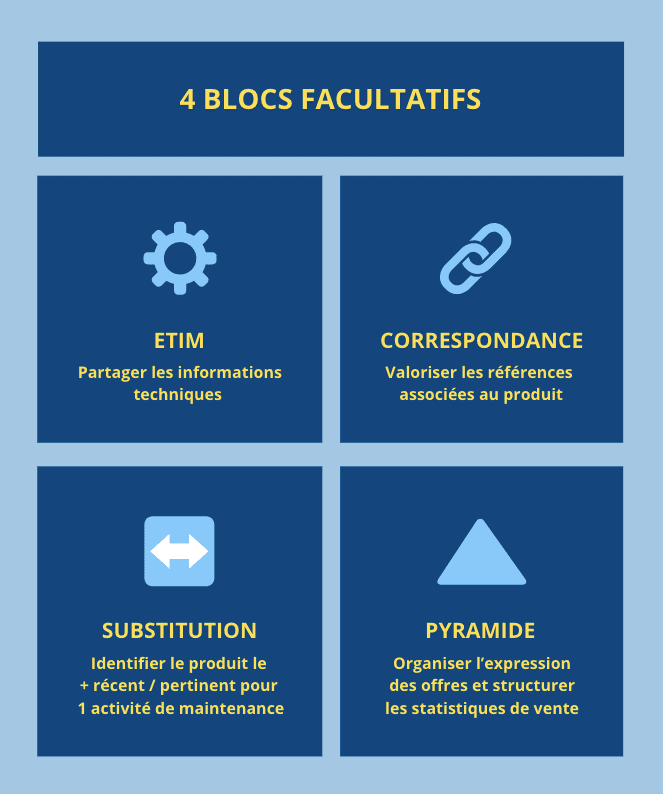
- Tab number 6, called ETIM, lists technical characteristics such as: resistance to extreme temperatures and to impact, constituent materials, color codes, flow rate and power, etc.
- Tab number 7 is titled PYRAMIDE and helps structure the offering and the measurement of sales by including: product line name, coding, etc.
- Tab number 8 is named SUBSTITUTION, because it lists the most current product, the one that is most relevant for maintenance work.
- Tab number 9 carries the name CORRESPONDANCE and gathers the information that showcases the references associated with the product, such as: correlation with optional or auxiliary products, components, etc.
3 free-structure blocks
Manufacturers can use 3 blocks of optional information that are useful for commercial negotiation:

- The REMISE block: it specifies the commercial agreement initiated by the manufacturer, the terms that set the mutual order commitments.
- The ANALYSE block: it provides information on price differences over time, depending on changes in product references, discount categories, etc.
- The SPÉCIFIQUE block: it gives distributors additional information, for example about the manufacturer’s various logistics centers.
Reference tables in a companion file
A file published by the FAB-DIS committee lists more than 12 value tables and establishes specific coding to guide the people who create FAB-DIS files.

Here are the main FAB-DIS reference tables:
- a table of units: to detail the base unit and the packaging in particular, in order to reduce incorrect information and optimize listing.
- a categorization of media data: to include the images, videos and marketing descriptions (…) that showcase the product.
- coding for eco-contribution: to apply the right rules in response to environmental requirements.
- a list of compliance certificates: to attest to the NF mark (French standards), for example, and thereby showcase a product.
- a typology of related regulations: to prove mandatory compliance on certain products (F-GAS, batteries, SDS and wood in particular).
- an inventory of countries: to state the country of origin and the original characteristics in line with the coding of the ISO 3166-1 standard,
- a classification of wood species: to comply with traceability and the legal provisions of EUTR Regulation No. 995/2010.
- a classification of battery and cell categories: to meet compliance with international air freight conditions for batteries and accumulators.
Automated generation and import of FAB-DIS files with a PIM
In this section, we highlight the advantages that the Afineo PIM solution brings to manufacturers and distributors when exporting and importing files in FAB-DIS format.
FAB-DIS file: manual creation and the risk of errors
Despite all the benefits, filling in the standardized FAB-DIS Excel file by hand does have a few drawbacks:
• the task remains time-consuming and laborious for a human being,
• the built-in nomenclature is not always easy to comply with,
• the coding of the reference tables is highly complex to take on board,
• important data can easily be forgotten.
Conclusion: manual creation therefore costs time and people, with a very high margin of error.
Those errors in turn trigger new checks and changes that hurt the listing of offerings, and therefore revenue growth.
For all these reasons, using a PIM solution is recommended. Let’s see why.
FAB-DIS connector: making your file complete and compliant
The Afineo PIM solution (Product Information Management) is product data management software in which a company centralizes all the information about its items, including the multimedia files.
Data is centralized through file imports, feeds, and connections with various information systems: ERP, CRM, etc.
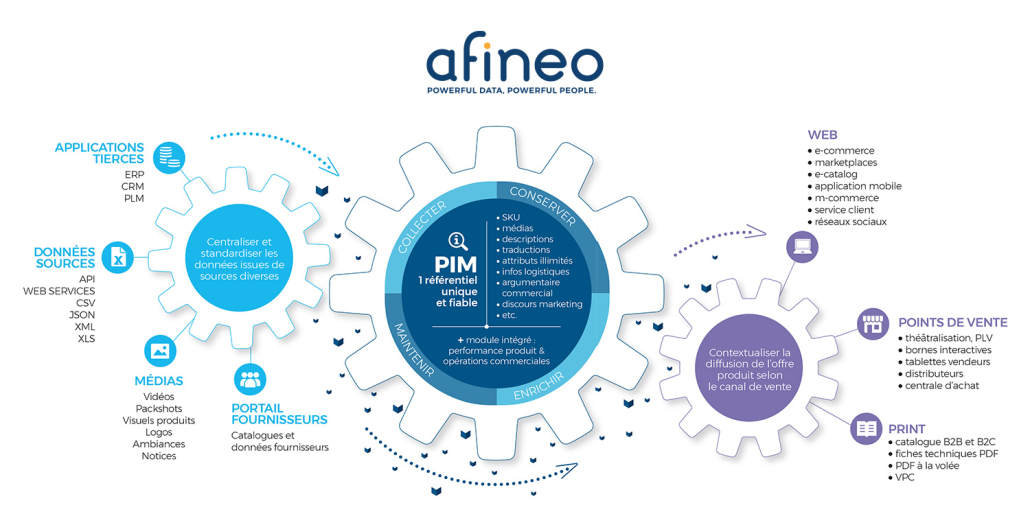
The FAB-DIS connector of the Afineo platform resolves every point of friction that manual production involves:
- the FAB-DIS matrix is built into the platform to model all the data according to the required nomenclature,
- the coding of the reference tables is configured in the software to match your business context,
- the ETIM specifics of your trade are incorporated to standardize the data,
- the Excel files exported (or imported) are therefore compatible and standardized, so they pass the Easy-Check compliance test successfully.
Automation in the PIM software removes any risk of error and makes it possible to produce FAB-DIS files that are absolutely complete and compliant.
Manufacturers: generate your FAB-DIS files automatically
On the manufacturer’s side, the data must be ready, meaning modeled in the PIM according to the FAB-DIS nomenclature.
Modeling your product data rigorously upfront is what makes it possible to automate the creation of a FAB-DIS file.
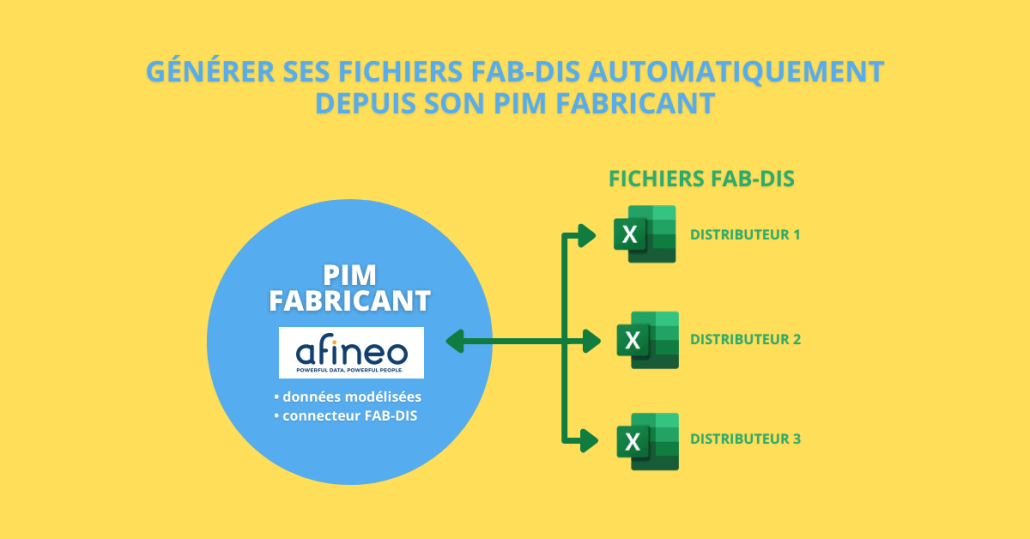
Manufacturers can then rely on the strengths of the Afineo PIM solution:
- a mapping feature to standardize the PIM software’s coding according to FAB-DIS standards,
- a work and validation workflow to speed up business processes,
- a natively integrated DAM to associate multimedia files easily,
- configurable conditions to match images, videos, product correspondences, etc.
- a high-performance export engine to generate your FAB-DIS file automatically.
What is more, by centralizing your data you gain comfortable real-time visibility over your flows of available raw materials, deliveries, etc.
You thereby keep control over the life cycle of every product.
Distributors: import FAB-DIS files in an automated way
On the distributor’s side, automatic import of FAB-DIS files also makes the teams’ work easier.
All you have to do is configure the set of attributes for the product data upfront, in line with the FAB-DIS nomenclature and the coding of the reference tables.
Configuration is faster thanks to “cascading” assignment!
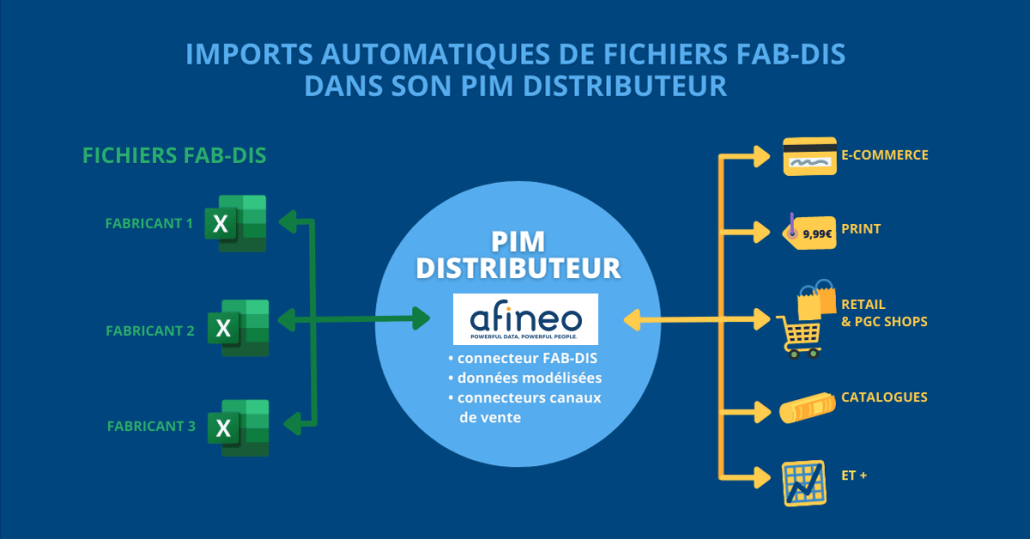
Using the FAB-DIS connector and an import template, distributors automatically import the FAB-DIS files supplied by manufacturers: the product data in the tabs is automatically classified and filed so that it can be used.
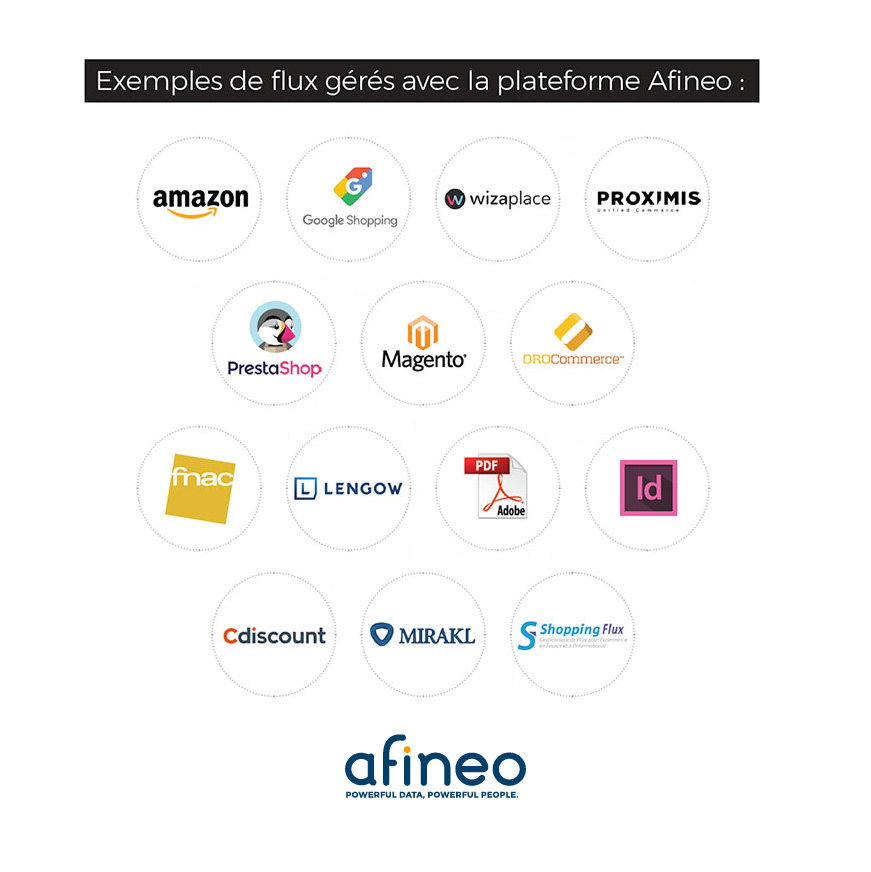
Distributors also use a wealth of connectors to syndicate product information
and successfully bring their commercial offering to market on every sales channel: e-commerce sites, marketplaces, printed or online catalogs, in-store signage, etc.
Thanks to the natively integrated DAM, syndication also covers photos, videos, instruction sheets, etc.
Afineo PIM solution: high-performance data exchange for the business
If the Afineo platform is used by demanding brands, it is certainly because it offers more features than a simple PIM DAM solution, but also because our team provides systems and software consulting.
Our product data management consultants make a point of looking at the technology stack your teams use, in order to propose modular software suited to your context and to your own business challenges.
Results:
- operational reference data,
- from +50% to +80% in productivity,
- growing revenue,
- a manufacturer-distributor relationship in great shape!

Having data is essential. Being able to use it to grow your revenue is even better!
Beyond the benefits specific to Fab-Dis exchange, adopting a PIM opens the door to all the advantages of centralized product data management: accelerated time-to-market, a broader catalog, easier international rollout.
What do you think? We look forward to discussing it with you: contact us!
Key takeaway: the FAB-DIS format summarized in an infographic
To make it easier to take in and to help you remember the essentials, here is an infographic that summarizes the FAB-DIS format, along with the strengths of the Afineo PIM solution for manufacturers and distributors:

💡 New to the subject? Read our complete guide: What is a PIM?

Grégory Coste
Consultant en marketing digital SaaS, il accompagne Afineo dans la création de contenus clairs et pédagogiques pour valoriser les solutions PIM, DAM et MDM. Sa mission : rendre simples et accessibles des sujets complexes.
 Afineo, a key player in reference data management, offers a SaaS MDM, PIM and DAM platform to support the digital transformation of businesses. Our multi-domain cloud solutions make data management and data quality easier, while ensuring smooth integration with your digital ecosystem.
