Digital Product Passport (DPP): definition, regulation and implementation
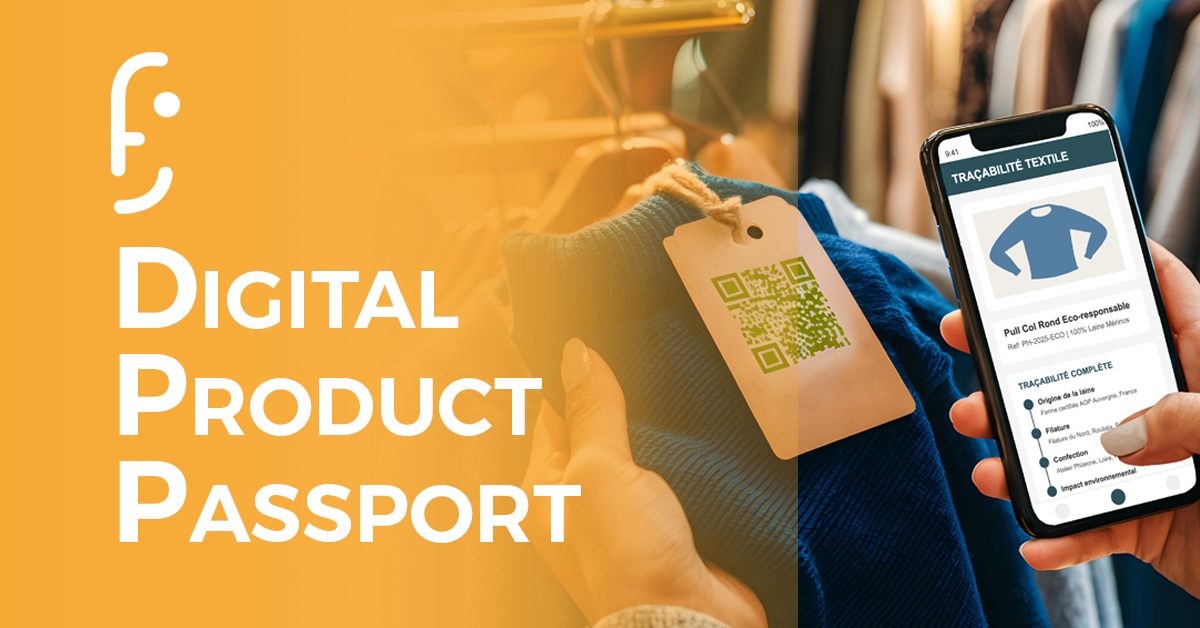
Discover all our advice for making a product data management project a success and for successfully rolling out your product passports.
- The Digital Product Passport (DPP) is a scheme regulated by the European Commission to support the circular economy.
- It centralizes a product’s key information, in particular its origin, composition, repairability and recyclability.
- The DPP will gradually become mandatory by 2030, starting with sectors such as textiles, electronics and batteries.
- A PIM (Product Information Management) solution makes it possible to collect, structure and syndicate the data the DPP needs, efficiently.
- A well-implemented DPP turns a regulatory constraint into a competitive advantage: transparency, traceability and customer trust.
The Digital Product Passport is entering its operational phase. The European register of Digital Product Passports has been open since 20 July 2026. The first mandatory deadline concerns certain batteries from 18 February 2027. For companies, the subject is no longer limited to the QR code: above all, the data that will feed the passport has to be structured, made reliable and maintained.
What is a Digital Product Passport?
The Digital Product Passport (DPP) is a standardized digital record that brings together all the information about a product in order to guarantee its traceability, transparency and sustainability throughout its lifecycle.
The DPP comes from the European Commission’s determination to address the challenges of traceability and of the transition to a circular economy. As the following video explains, the passport is meant to make repair, recycling, reuse and resale easier:
This video is a good introduction to the subject…
The product’s digital identity card
In concrete terms, the digital product passport takes the form of a digital product record. Its purpose is to collect, centralize and communicate all the information relating to the product, throughout its lifecycle, with sustainable development in mind. Consumers, professional economic players and control authorities can each separately access the information that concerns them: transparency, completeness, compliance, sustainability, circularity and more.
European regulation on the DPP
The Digital Product Passport, or digital product passport, is gradually becoming mandatory in the European Union under the ESPR (Ecodesign for Sustainable Products Regulation), with implementation spread out until 2030 depending on the sector.
Adopted by the European Union and in force since 18 July 2024, the ESPR regulation succeeds the 2009 Ecodesign directive. It considerably extends its scope, since it now covers almost every category of product placed on the European market, with the notable exception of foodstuffs, medicines and certain vehicles.
The digital product passport is one of the key measures introduced by the ESPR. As the European Commission makes clear, it is designed to make essential information accessible on products, their components, their materials, their compliance, their durability, their circularity and their lifecycle.
The ESPR is part of the 2020 Circular Economy Action Plan, whose purpose is to make the transition to a lasting circular economy easier, while supporting the commercial performance of economic players.
Since the summer of 2026, the scheme has entered an operational phase: the European Commission opened the European register of Digital Product Passports on 20 July 2026. The register lists the unique identifiers and the metadata attached to the passport, while detailed product data remains managed in a decentralized way by the economic operator responsible. For electric vehicle batteries, light means of transport batteries and industrial batteries above 2 kWh, the battery passport becomes mandatory from 18 February 2027.
→ official European Commission source
→ official source for the battery date
What this means for companies
Companies are responsible for creating and updating the Digital Product Passport for every product placed on the European market.
Is a company placing its product on the European market? Then it is the one that must provide the associated digital passport. The company therefore has to deliver up-to-date, reliable information, while including the legal or mandatory data. The ESPR regulation thus requires information on components, materials and anything else useful in order to encourage durability and circularity. Legal compliance becomes more demanding in this respect.
What is the Digital Product Passport for?
The Digital Product Passport makes it possible to improve product transparency, guarantee traceability and make recycling easier throughout the product lifecycle.
Objectives and benefits of the DPP
The Digital Product Passport aims to strengthen the transparency, traceability and durability of products throughout their lifecycle. The digital product record supports efforts to move toward a circular economy. Centralizing information and making it accessible is intended to keep improving product durability, and to fight planned obsolescence, by taking into account how the product is handled at end of life.
Objectives of the regulation on the Digital Product Passport
The first aim is to bring every player into a circular approach: raw materials suppliers, distributors, consumers, repairers, recyclers, public authorities and more.
Once they are informed in full transparency, those players can take an active part: backing and supporting eco-design, repair and reuse initiatives. The overall ambition is to let companies meet current and future European regulatory compliance requirements more easily, while putting this information in front of consumers, who become better informed and more alert to what is at stake.
Benefits for companies
Ensuring exemplary, responsible compliance with European regulation lets every player show a clean record, as opposed to a greenwashing that is now unwelcome in everyone’s eyes. Each company also guarantees the traceability of all its products, and so improves its supply chain management. The DPP also makes it possible to certify the authenticity of a brand or a model in order to fight counterfeiting. More broadly, the product passport lets companies strengthen their communication, enriching the product experience with exclusive, aspirational or useful information, or meeting regulatory requirements still to come. Beyond compliance, equipping yourself with a PIM to manage your DPPs gives you access to all the benefits of Product Information Management: centralized data, faster time-to-market, product records enriched across every sales channel.
Benefits for consumers
The digital product passport becomes a useful, instructive source of information for genuinely guiding a purchase according to needs, desires and values. Everything becomes instantly accessible: origin, composition, repairability and recyclability of the product, certification (essential for luxury goods). Given data that highlights sustainable product design, consumers naturally steer their purchases that way and favor brands that reduce their environmental impact.
Which products are concerned by the DPP, and what data will be accessible?
The Digital Product Passport gradually concerns every product placed on the European market, with priority given to sectors such as textiles, electronics and batteries.
Product information stored in the digital product passport has to circulate smoothly between all players: producers, importers, distributors, repairers, recyclers, consumers and more. The nature of the data that favors the circular economy should indeed steer behavior in the right direction.
The products concerned by the DPP passport
As early as 2023, CIRPASS, a consortium of 31 partners mandated by the European Commission, worked on the first applications of the digital product passport. That work focused in particular on three categories considered a priority at that stage: batteries, textiles and electronics.
Since then the regulatory framework has become clearer with the publication of the 2025-2030 ESPR working plan, adopted by the European Commission in April 2025. This plan identifies the first product categories that will be subject to new ecodesign and product information requirements in the years ahead. The priority sectors include textiles and clothing, iron and steel, aluminium, furniture, mattresses and tyres. The Commission also plans horizontal measures on repairability, in particular for consumer electronics and small household appliances.
The digital product passport is to come into force gradually by 2030, depending on the sector and on the delegated acts that will be adopted product by product or by group of products. The future requirements will cover both product performance (durability, repairability, energy efficiency, recycled content) and the information to be made accessible, mainly through the Digital Product Passport.
Batteries are a special case: they fall under a specific regulation, the European battery regulation, and are among the first categories concerned by the rollout of a digital passport. This priority is explained by the traceability, recyclability, performance and lifecycle issues attached to that industry.
Construction materials are also covered by a specific regulatory framework aimed at manufacturers, importers and distributors.
In time, the DPP is meant to spread gradually to many sectors: luxury, textiles, electronics, furniture, optics, industrial equipment, mobility and more.
The main data in the digital product passport
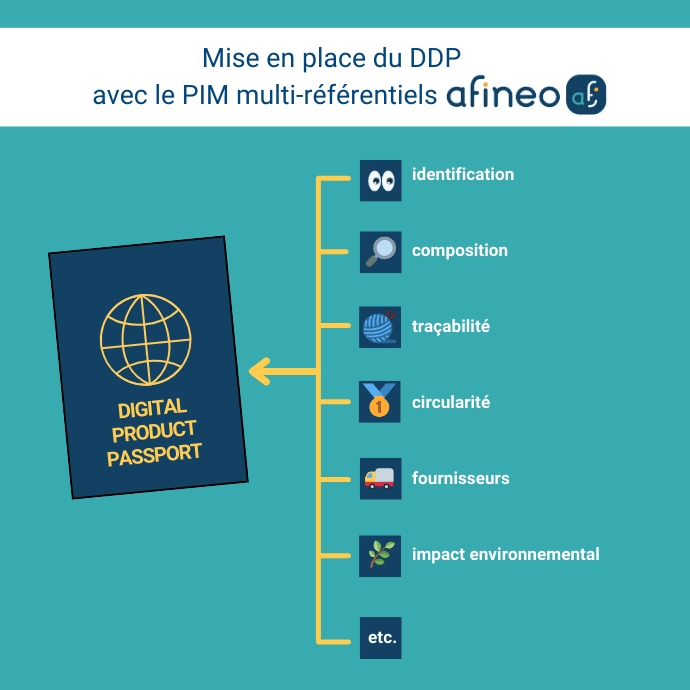
A Digital Product Passport must contain several categories of data: product identification, composition, traceability, circularity information, performance and environmental impact. The European Commission is progressively specifying the requirements for each product category. The table below sets out the types of data that must be included in a digital product record.
| Product data category | Examples |
|---|---|
| Identification | Intrinsic data such as the name, the trade name, the model, the batch number, the manufacturing date and the warranty details. |
| Composition | The raw materials used or recycled, regulated substances, components, toxic or polluting substances. |
| Traceability | The various geographic origins of the materials or components, the identification of suppliers and the associated certifications. |
| Circularity | The level of repairability, reuse and recycling, dismantling instructions, the spare parts available and the corresponding recycling players. |
| Performance | Technical characteristics, certifications, labels, expected service life, care and maintenance recommendations. |
| Environmental impact | CO₂ emission rate, carbon footprint linked to production, delivery and use processes. |
This non-exhaustive list will grow according to the European Commission’s directives…
Examples of digital product passports
A Digital Product Passport relies on a unique identifier (QR code, RFID or blockchain) giving access to a digital product record that holds all the product’s information.
That identifier can appear directly on the item, on its packaging or in its user booklet. Once scanned, it gives access to the product data, with different access levels depending on the user (consumers, repairers, manufacturers and so on). These identifiers can take various forms. Let us look at a few examples of Digital Product Passports:
The QR Code at H&M
The digital passport for H&M’s textile products is accessible through a QR code.
The Essentials collection for men led the way and was the first to offer a wealth of information for each item: the product’s journey including the stages the materials went through, care advice and recycling recommendations. Enough to make “sustainable preference” easier.

The RFID tag at Decathlon
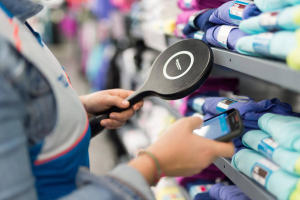
The digital passport for Decathlon products: the RFID tag (radio frequency identification).
The reasons for this choice: RFID technology uses little energy and improves product traceability and operational efficiency, from manufacturing through to points of sale, worldwide. This environmental performance gives customers access to a digital product record rich in data: the type of textiles and materials used, their origins, and a host of other elements that inform the buyer.
Blockchain at Fnac Darty
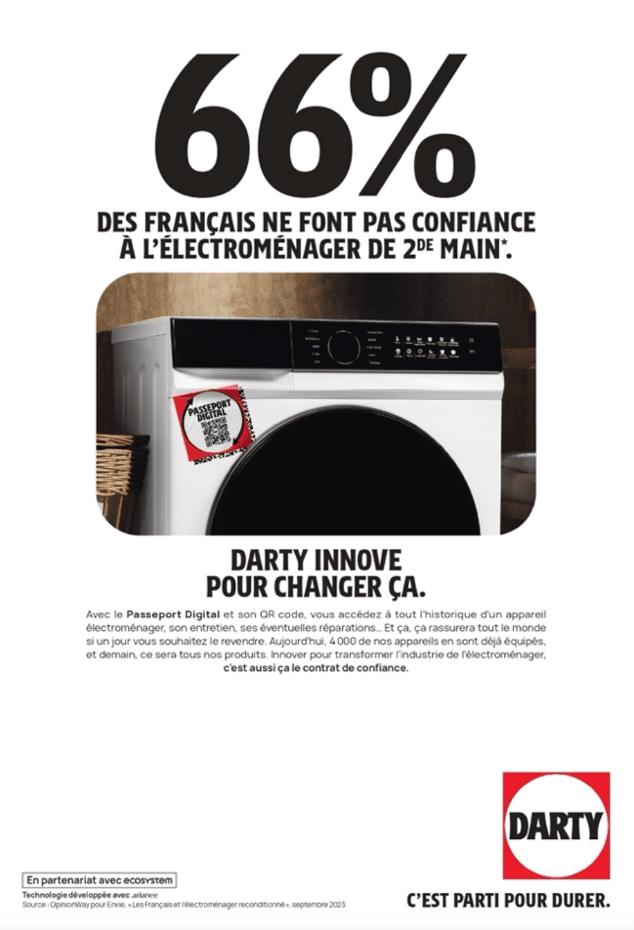
Darty uses its digital product passports with a view to making its items last longer. The technology offers interactions with the blockchain through a QR code. Customers and maintenance professionals have access to the information they need: product history, origins, manufacturing data, repair and refurbishment actions, care advice and more.
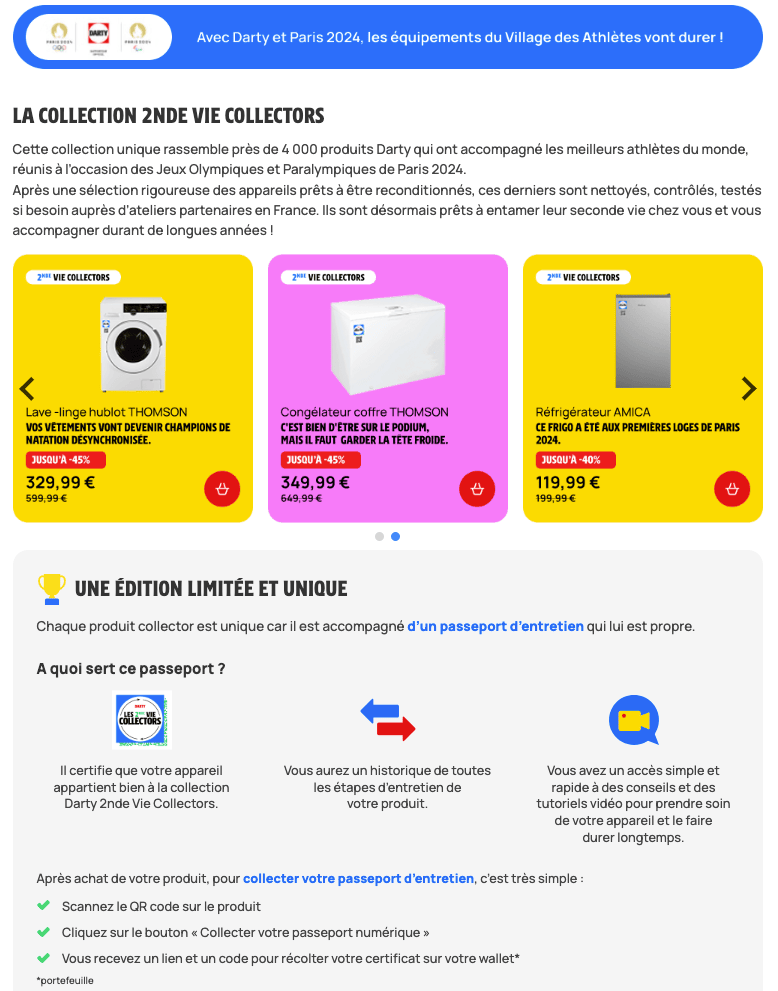
The “2nde vie collectors” collection brings together 4,000 appliances refurbished from their first life at the Paris 2024 Olympic Games and introduces the first digital passport tracing the lifecycle of household appliances:
Other technologies will surely emerge, such as physical marking, also known as digital hallmarking, which guarantees the authenticity of valuable objects through a tamper-proof digital certification system. Reading the code gives access to a secure digital environment on blockchain.
The barcode (the star of the 1980s) can do the job in terms of access. It offers far less flexibility, however, when it comes to access rights to information.
Making the rollout of the Digital Product Passport a success
Making the rollout of a Digital Product Passport a success requires structuring and centralizing product data in order to guarantee its reliability and compliance.
This project also means taking on several challenges, in particular data management, working with partners and securing information. We point you toward a suitable software solution and guide you through a roadmap to carry your rollout through.
The PIM solution for mastering all your data
A PIM plays a central role in rolling out the Digital Product Passport by making it possible to collect, structure, centralize and syndicate the product data compliance requires.
Afineo’s PIM software offers the ability to manage several data domains (supplier domains, raw material and component domains and more) by centralizing in them all the data coming from various information systems, family by family. You cross-reference the information from these different domains in order to communicate data flows.
These flows are originally intended to build complex commercial offers easily and to enrich online product records, for example.
In the same way, you configure your domains by associating the relevant data in order to feed a product passport with all the required information: identification data, materials, origins, supplier names, location, spare parts and more.
You configure domains suited to the various categories of information required (see the table above) in order to comply with the regulation, and you generate digital product passports offering complete information to the consumer, but also to the professionals concerned (reuse and recycling players and others).
The PIM is designed as a collaborative space where suppliers and buyers can work together by integrating their business processes, in order to speed up the centralization of product information and digital assets: the Afineo PIM natively includes a DAM (digital asset management) to centralize multimedia files, such as certification images, repairability indices in visual format and more. Those files can therefore feed the product passport.
You can also face the next regulatory constraints by creating a new domain when the time comes.
The roadmap for getting ready for ESPR compliance
Rolling out a Digital Product Passport rests on several steps: identifying the products concerned, collecting the data, structuring it in a domain, generating the digital records and deploying gradually.
Bring your teams into the project: make them aware of what is at stake with the DPP and involve them in building the data domains. Support every stakeholder through the change.
Start by identifying every product concerned by the digital passport and determine the essential information to collect for each reference, as well as your partners such as suppliers. This is how you establish your map of products, data and information flows.
Define structured procedures for gathering, checking and organizing the data collected, centralizing it within the various domains of your PIM. Managing data centrally guarantees its reliability, its regular updating and its accessibility for everyone involved in the product lifecycle.
Use the information provided to build digital product records that comply with the requirements set by European regulation, including the data families compliance demands. To finalize the DPP rollout, attach a unique identifier to each product record, in the form of a QR code for example.
Deploy in stages, test, experiment. Assess how reliable your system is and correct any malfunctions, drawing on user feedback.
Are you up and running? Tell your customers the digital passport exists and highlight the sustainability benefits for them, along with your commitment to a more circular economy.
Frequently asked questions about the Digital Product Passport
Is the Digital Product Passport mandatory?
Yes, gradually. The ESPR regulation, in force since July 2024, makes the DPP mandatory for the product categories targeted by the European Commission through successive delegated acts. Batteries lead the way in February 2027, followed by textiles, electronic products, furniture, iron and steel, aluminium, tyres and mattresses over the 2025-2030 period.
What is the difference between the DPP and conventional product labelling?
The DPP is a structured digital file, accessible through a unique identifier (QR code, NFC, RFID), that brings together the product’s whole lifecycle: composition, origin of materials, carbon footprint, supplier traceability, repair and recycling conditions. Conventional labelling is limited to static printed information (origin, composition, instructions for use). The DPP is dynamic, traceable and auditable.
What is the penalty for DPP non-compliance?
Penalties are defined by each member state. They can include administrative fines, withdrawal of products from the market and a ban on placing them on the European market for serious breaches.
Does the DPP apply to SMEs?
Yes, as soon as the SME places on the European market a product falling within a category covered by an ESPR delegated act. No general exemption is planned for company size, but the implementing rules may allow for adjustments (deadlines, simplified formats) on a case-by-case basis.
How do you get ready for the DPP in practice?
The first step is to map the existing product data and identify the gaps against ESPR requirements: composition, traceability, environmental data, suppliers. Companies then centralize that data in a PIM platform able to structure it, version it and expose it through a DPP-compatible interface. The first regulated players (batteries) are starting their projects from 2025 in order to be ready in 2027.
To go further, we have set out the five questions to ask in order to assess how mature your product data is for DPP 2027 and identify the data to structure first.
Lost in the jungle of the digital product passport and data management?
Grab the vine Afineo is holding out.
We support many companies in putting their product data management strategy and their Digital Product Passport in place: Groupe Lafreto OUTDOOR (Glisshop.com, monsieurgolf.com, glisse-proshop.com and lunettes-de-soleil.fr), Lafuma Mobilier, Distri Club Medical, Flunch, Mr. Bricolage, Groupe Alliance Marine, Jouéclub and more.
💡 New to the subject? Read our complete guide: What is a PIM?

Grégory Coste
Consultant en marketing digital SaaS, il accompagne Afineo dans la création de contenus clairs et pédagogiques pour valoriser les solutions PIM, DAM et MDM. Sa mission : rendre simples et accessibles des sujets complexes.
 Afineo, a key player in reference data management, offers a SaaS MDM, PIM and DAM platform to support the digital transformation of businesses. Our multi-domain cloud solutions make data management and data quality easier, while ensuring smooth integration with your digital ecosystem.
