Product domain: definition and 6 tips for building one

What is a product domain? How do you build a product domain that meets business, marketing and commercial needs?
A product domain is an information system that brings together all the data relating to the products a company sells, in the broadest sense: product description, technical characteristics, visuals, prices, variants and associated metadata.
It must make it possible to structure, make reliable and syndicate information consistently across every sales channel.
In an environment where consumers compare, inform themselves and demand ever more transparency, the quality of product information is a genuine lever for commercial performance.
Collaborative platforms such as Open Food Facts, and the apps consumers use every day, raise their expectations: product information that is reliable, exhaustive and accessible.
The finding is clear: only perfectly reliable information triggers the sale.
Faced with this, structuring product data becomes unavoidable. Companies rely for this on solutions such as the PIM (Product Information Management), also called MDM (Master Data Management) solutions, combined with a DAM (Digital Asset Management), in order to centralize and make the most of product information and the content that goes with it.
The key takeaways:
- A product domain centralizes all product data in a single source.
- It guarantees consistent information across every sales channel.
- It is essential to an omnichannel strategy.
- It relies on tools such as the PIM and the DAM.
- A well-structured domain improves productivity and speeds up go-to-market.
Tip 1: grasp what omnichannel selling involves
Omnichannel selling calls for consistent product information across every channel, to guarantee a smooth and effective customer experience.
In this context, the growing number of sales channels and of suppliers makes product data management considerably more complex.
In an environment where data quality has become critical, nearly 74% of companies without a PIM report problems with the reliability of their product information.
Publishing commercial offers online brings constraints tied to multichannel e-commerce (Amazon requires you to comply with its rules or see your product delisted) and to organic search, in order to optimize your digital marketing.
The customer journey has to be mapped out with consistent information across every channel: catalogs, stores, e-commerce sites, and so on.
Consumer expectations, and the means consumers have to voice them (reviews, social networks, mobile apps and more), oblige companies to syndicate reliable, complete product information.
Apps such as Yuka or Open Food Facts are a perfect illustration of this shift toward greater transparency.
A well-structured product domain is a strategic and operational answer for companies that want to master everything omnichannel selling involves.
Enriching product data and industrializing business processes make it possible to control, manage and syndicate the offer with flawless completeness and greater responsiveness:
these are now the conditions for meeting consumer expectations while staying competitive.
Product data quality also contributes to customer loyalty, and to generating additional sales through cross-selling and up-selling in particular.
Tip 2: understand what a product domain is
Let us give a simple definition of the term product domain:
• it is an information system that forms a single domain for the data on the products sold by a company,
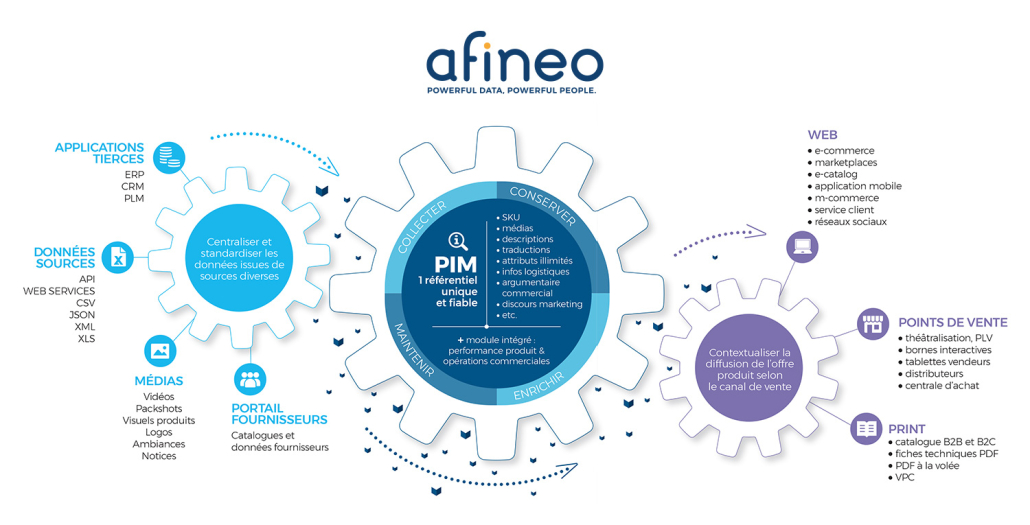
• a domain brings together in one place all the information and digital assets (when coupled with a DAM) that were until then scattered across various data sources (ERP, CRM, EDM, Excel files, and so on),
• it is a large-scale digital project with a strategic dimension, aimed at improving team productivity and sales performance,
• the companies that build a domain to improve their competitiveness are retail and mass-market players, manufacturers, retailers and e-merchants,
• a product domain is designed to make life easier for several roles: marketing and communications project manager, IT, purchasing manager, logistics department, digital and e-commerce project manager, and so on.
• the domain is a genuine toolbox offering several functions: syndicating offers across the various sales channels (e-commerce sites, marketplaces, printed product catalogs, and more), communicating logistics standards, and so on.
• the product domain is a subset of MDM (Master Data Management), with MDM itself covering several data domains in a multi-domain approach.
Tip 3: know the benefits for your business
Why build a high-quality product domain? Let us look at the advantages and benefits your company can draw from a product domain.
First of all, centralizing data within a single product domain makes it possible to eliminate errors and duplicates, because poor data quality has a direct impact on performance : between 22% and 30% of e-commerce returns are linked to inaccurate or incomplete product information.
By natively integrating a Supplier Portal into your domain, as is the case on the Afineo platform, your purchasing manager smooths and speeds up the relationship with your suppliers, in particular by obtaining usable product data that feeds straight into your domain.
By using a collaborative workspace where product information management and business processes come together, your business teams gain in operational performance. They hold and syndicate reliable and validated information. Time-consuming, tedious tasks are automated. The Afineo platform includes a configurable workflow: it lets you break processes down into steps to keep work flowing. Brought together around the product offer, your teams gain in efficiency, productivity and responsiveness.
The product domain also carries the great advantage of speeding up go-to-market: by maintaining the quality of your data within the platform, you are ready to syndicate your product offers. You can even tailor how they are syndicated depending on the sales channel, within the Afineo platform: your printed product catalogs, your e-commerce site, your presence on marketplaces, and so on.
A collaborative platform such as Afineo lets you maximize your commercial profitability by building profitable offers from your product performance. You can also configure product associations and generate additional sales through multichannel e-commerce.
Tip 4: prepare the rollout of your domain
How do you build your product domain?
Here, in table form, are the questions the project owner should ask in order to build a high-performing product domain for their retail and/or e-commerce business:
| Questions to ask | Purpose of the questions |
|---|---|
| Who should I talk to in the company? Which roles are concerned by product data? | To identify every need, it is essential to work collaboratively, involving IT, marketing, the e-commerce manager, the purchasing manager and every colleague concerned by product data from the outset. |
| Which tools are used internally to manage product information? | The point is to identify the obsolete technology stack, eliminate shadow IT, identify what is missing, and also list risky or counterproductive practices. |
| What are the uses and needs around data sourcing, content management and product data syndication? | Each role must detail its missions, tasks and current processes, in order to identify areas for improvement |
| What are the requirements of each role in the company? | You need to determine what each role absolutely requires: your product domain must take on board the constraints specific to each one, to help it carry out its missions and reach its objectives. This determines part of the features of the tool to be implemented. |
| What is specific to each communication and sales channel? | By listing every channel and the constraints that go with it, you define the list of features needed to syndicate and tailor the offer. |
| What must the product domain improve? What are the objectives? | Set down in writing what your tool must make possible: improving data quality, teamwork and supplier relationships, speeding up time-to-market, and so on. |
| Which software solutions must your tool be able to communicate with? | The aim is to list the technology constraints in terms of interoperability, in particular to generate and syndicate product records for multichannel e-commerce, and to smooth data exchanges through internal flows (ERP, logistics, stock, and so on). |
| How digitally mature are the future users of the domain? | You need to assess your users’ digital skills in order to detect training needs. |
| Who will train my future users? | It is crucial to devote time to making your users operational and self-sufficient. |
Tip 5: choose the right software solutions
Have you identified the needs, uses and constraints specific to your business? Good! You have therefore listed the features you need.
Even though we have already deployed many domains, we cannot present the ideal tool for your company without knowing you, since every business has its own particularities.
Here, however, are the product data management solutions you need to tell apart on the market:
- PLM (Product Lifecycle Management): used by manufacturers, this type of tool manages the product lifecycle and the data attached to it, from design to manufacturing and through to maintenance. Once the product is ready to be sold, a PIM must take over.
- The Supplier Portal: this solution is widely used by distributors, because it optimizes information sourcing by collecting the right data from suppliers, and speeds up the commercial relationship.
- The PIM (Product Information Management): a product information management software brings together all the information needed to market the product offer. The PIM is the single domain for your product information, and lets you syndicate it across your sales channels.
- The DAM (Digital Asset Management, or Data Asset Management): this is a solution for managing digital assets, commonly called media (image files, photos, videos, sound, and various documents including the user guides for certain products). The DAM is the single domain for your assets, and lets you syndicate them across your channels.
- PXM (Product Experience Management): this is a complete, powerful platform for managing the product experience, making it possible to push personalization of the offer according to context and sales channel in order to influence the purchase decision. This is the case, for example, with the Afineo platform, which natively integrates a PIM, a DAM, a Supplier Portal and a Product Performance and Commercial Operations module, along with reporting features for making the best business decisions.
Tip 6: call on an experienced software publisher and integrator
A product domain is an IT project that takes place in a context of digital transformation.
The software publisher must show experience at several levels to be able to support the company in building and integrating its domain:
- in the opportunity audit phase, to analyze needs, uses and technology constraints,
- in the integration phase, configuring features and running tests,
- in the user training phase,
- in the maintenance phase for the deployed solution.
The publisher must be rigorous, because it stands behind the solutions it deploys: its command of business challenges and of the right software solutions is what allows the company to reach the performance it expects.
Afineo, a French pioneer in Data and Media Management, is a publisher and integrator of innovative SaaS software.
Since 2004, we have supported retailers, e-merchants and manufacturers, from the audit phase through project management to the deployment of their domains, and we train users to make them self-sufficient and effective.
Our client references are evidence of our ability to steer your digital project from A to Z.
Are you struggling to structure your product domain?
Let’s talk about your project.
Frequently asked questions about the product domain
What is the difference between a product domain and a product catalog?
The catalog is a commercial, customer-facing view: selected products, showcased, organized by sales universe. The product domain is a single structured source that holds all the company’s product data (technical, logistics, marketing, multilingual, multichannel). The catalog is a projection of the domain, not the other way around.
Do you need a PIM to manage your product domain?
Not always. For a few dozen references managed by a single team, a spreadsheet may be enough. But as soon as product data is contributed by several teams (purchasing, marketing, e-commerce, quality) or syndicated across several channels (website, marketplaces, distributors, printed records), a PIM becomes essential to guarantee the integrity, traceability and automatic syndication of the domain.
What data should a product domain contain?
At minimum: unique identifiers (SKU, GTIN/EAN), labels, technical attributes (dimensions, weight, composition), classifications, prices, logistics data and associated assets. Mature domains also include multilingual and multi-country variants, environmental data, supplier traceability and version history.
How long does it take to set up a product domain?
From a few weeks to several months, depending on scope. An SME with 1 to 3 sales channels and a homogeneous catalog can structure a first operational domain in 6 to 12 weeks with a SaaS PIM. An international multi-brand company, with an existing ERP and complex supplier flows, should generally allow 4 to 9 months for a full deployment.
📘 Want the full picture of Product Information Management? See our reference page: What is a PIM?

Grégory Coste
Consultant en marketing digital SaaS, il accompagne Afineo dans la création de contenus clairs et pédagogiques pour valoriser les solutions PIM, DAM et MDM. Sa mission : rendre simples et accessibles des sujets complexes.
 Afineo, a key player in reference data management, offers a SaaS MDM, PIM and DAM platform to support the digital transformation of businesses. Our multi-domain cloud solutions make data management and data quality easier, while ensuring smooth integration with your digital ecosystem.
