• The Platform
    • REFERENCE DATA
      • Multi-Domain MDM Governance & data quality
      • Espace
      • Group Multi-Entity MDM Data consolidated across subsidiaries
      • Espace
      • PIM software Centralized product information
      • Espace
      • Multi-domain PIM Cross-reference your product data
      • Espace
      • DAM Assets & digital media
    • SYNDICATION & PRODUCTION
      • Publishing Automated catalogs
      • Espace
      • Afineo Online Proof Approval Digital, controlled proof approval
      • Espace
      • Print-in-Store Customized in-store signage
      • Espace
      • Supplier Portal 24/7 data collection
      • Espace
      • Distributor Portal Self-service catalog
    • INTELLIGENCE & ANALYTICS
      • NEO AI The AI that understands, enriches and activates your product data
      • Espace
      • Product Performance and Sales Campaigns Sales campaigns & unsold stock
      • Espace
      • Distribution Network Management Steer your network performance, store by store
      • Espace
      • The Afineo Platform: Overview An overview of every solution Explore →
    • Request a demo
      • Request a demo
  • Your Challenges
    • BY INDUSTRY
      • Fabricants Multichannel & domains
      • Espace
      • Distributors Catalog performance
      • Espace
      • Consumer Goods FMCG & data syndication
      • Espace
    • BY CHANNEL
      • PIM to E-commerce Product records that convert
      • Espace
      • PIM to Marketplaces Amazon, Cdiscount, FNAC…
      • Espace
      • PIM to SEO Structured data & rankings
      • Espace
    • BY ROLE
      • Product Manager
      • Marketing
      • Communications
      • IT
      • Digital
      • Procurement
      • Sales Teams
    • Request a demo
      • Request a demo
  • Resources
    • LEARN
      • Blog
      • Espace
      • What is a PIM?
      • Espace
      • What is a DAM (Data Asset Management)?
      • Espace
      • Master Data Management: definition, challenges and solutions
      • Espace
      • Glossary
    • EVALUATE
      • PIM Benefits Concrete benefits for retailers and manufacturers
      • Espace
      • Calculate my PIM ROI Estimate your gains in 2 minutes
      • Espace
      • Espace
      • SERVICES
      • Espace
      • API Documentation
    • Request a demo
      • Request a demo
  • Afineo
      • About Us French SaaS vendor since 2004
      • Espace
      • Customer References References & testimonials
      • Espace
      • SERVICES
      • Espace
    • Request a demo
      • Request a demo
  • Afineo AI
  • Request a demo
  • English
    • French
  • Menu Menu
  • Request a demo
  • Our SaaS Solutions
    • NEO AI: the AI that really knows your product data.
    • The Afineo Platform: Overview
    • Multi-Domain MDM
    • Group Multi-Entity MDM
    • PIM software
    • Multi-domain PIM
    • DAM
    • Product Performance and Sales Campaigns
    • Distribution Network Management
    • Distributor Portal
    • Print-in-Store
    • Product Performance and Sales Campaigns
    • Publishing
    • Afineo Online Proof Approval
    • Print-in-Store
    • Supplier Portal
    • Distributor Portal
  • Your Challenges
    • PIM to E-commerce
    • PIM to SEO
    • PIM to Marketplaces
    • Distributors
    • Fabricants
    • Consumer Goods
    • Roles
  • Resources
    • Blog
    • PIM Guides
      • What is a PIM?
      • Why a PIM? 7 concrete benefits for your company
      • Calculate your PIM ROI in 2 minutes
    • What is a DAM (Data Asset Management)?
    • Master Data Management: definition, challenges and solutions
    • Glossary
    • SERVICES
    • API Documentation
  • Afineo
    • About Us
    • SERVICES
    • Customer References
  • English
    • French

DPP: the European registry is live, and the battery deadline reveals the real product data challenge
PIM Project - Product Information Management
DPP 2027 and structuring product data for the digital product passport
⏱ Reading time: 8 minutes

Published on 21 August 2026

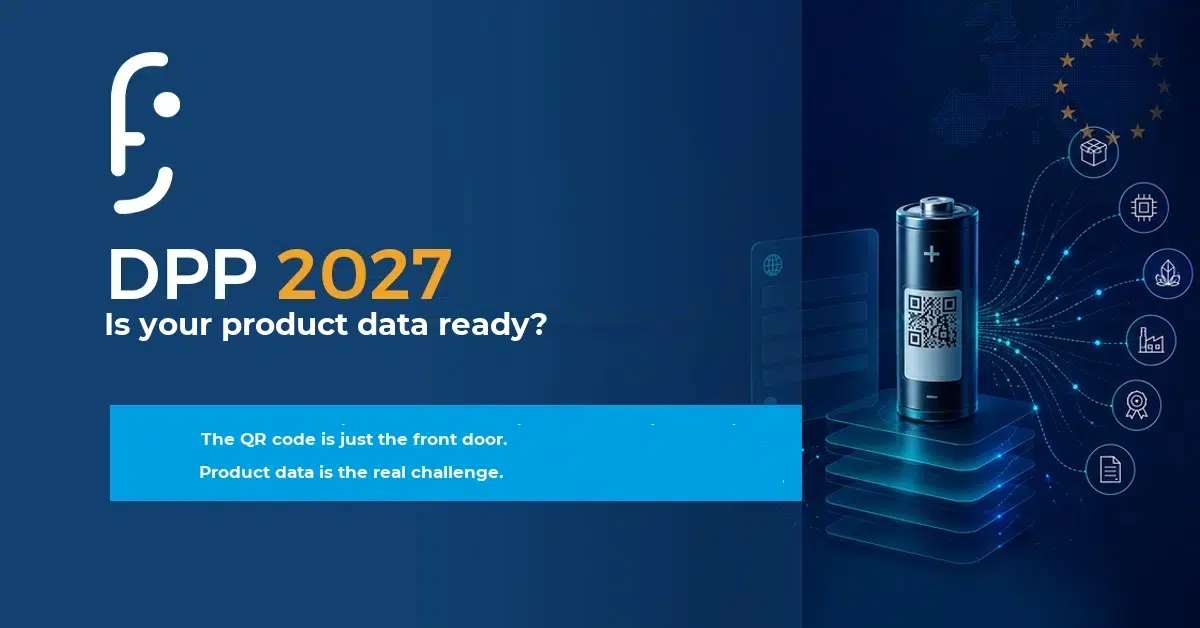
The digital product passport has just changed status. For two years, the subject stayed confined to regulatory texts and forward-looking roadmaps. That is no longer the case: on 20 July 2026, the European Commission brought the European registry of Digital Product Passports into service, along with a test environment. Implementing Regulation (EU) 2026/1778, adopted on 16 July 2026 and applicable since 6 August 2026, sets out how it operates.And on 18 February 2027, a concrete and non-negotiable deadline will open for the first product category concerned: electric vehicle batteries, light means of transport batteries and industrial batteries above 2 kWh will need a digital passport to be placed on the European market.For consumers, the promise remains the same: scan a product to access its composition, its performance, its repairability, its recycling conditions. For the company placing that product on the market, the reality is more demanding: before generating an identifier and a consultation interface, you have to be able to find the right information, know where it comes from, make it reliable and keep it up to date.

DPP 2027 is therefore, above all, a product data governance subject.

In brief
  • The European registry of Digital Product Passports has been operational since 20 July 2026; Implementing Regulation (EU) 2026/1778 has governed how it works since 6 August 2026.
  • The first mandatory deadline concerns batteries: from 18 February 2027, electric vehicle batteries, light transport batteries and industrial batteries above 2 kWh will need a digital passport.
  • The registry does not host the product data itself: it records proof that the passport exists, while the data remains managed by the company responsible for it.
  • The main challenge for companies is not the identifier (QR code, RFID) but the reliability, structuring and updating of the source data.
  • Five questions are enough to quickly assess the maturity of your product data against the DPP.
  • For the full definition of the DPP, the ESPR regulation and the detailed sector timetable, read our complete guide to the Digital Product Passport.

What the opening of the registry actually changes

The European registry is not a giant database centralizing information on every product sold in the Union. Its function is narrower: it allows a verified economic operator to record proof that a passport exists for a given product, at a level defined by the applicable regulation (model, batch or item depending on the case). The detailed data stays managed by the company responsible for the product, while the registry references the unique identifiers and the associated metadata.

Six technical standards have also already been published, covering unique identifiers, data carriers, APIs and system interoperability. In other words, the technical infrastructure of the DPP is no longer a point of uncertainty: for most companies, the gap left to close is no longer regulatory, it is organizational, and it concerns the data itself.

Regulatory timeline
20 Jul. 2026: registry live
→
6 Aug. 2026: regulation applicable
→
18 Feb. 2027: battery deadline

The window between the opening of the registry and the first sector deadline has already started closing.

This decentralized architecture has a direct consequence for you: the point is not to send a file to Brussels once and for all, but to maintain reliable, accessible and interoperable product data over time, ready to be exposed whenever the regulation requires it.

→

The complete guide to the Digital Product PassportDPP definition, ESPR regulation and detailed sector timetable: read our dedicated guide.

DPP 2027: batteries, the first full-scale test

Companies dealing with batteries are the first that will have to meet this requirement in practice, as early as February 2027. This case is revealing, because it immediately exposes the real complexity of the data required: product identity, chemical composition, carbon footprint, recycled content, performance, state of health, dismantling and recycling instructions. Not all of this information is intended for the same audiences either: some is accessible to any consumer, some is reserved for enforcement authorities or for parties demonstrating a legitimate interest, such as recyclers. And part of this information does not come from the company placing the product on the market, but from its suppliers and subcontractors.

What the battery passport reveals foreshadows a question other sectors will have to ask themselves as new categories enter the ESPR timetable (textiles, electronics, furniture, aluminium, tyres and mattresses in particular):

Is your information system able to reliably reconstruct the complete history of a product?

The real obstacle is not the QR code

A digital identifier is only a way in. It does not know whether a piece of data is correct, whether a supplier certification has just expired, or which of two contradictory versions of the same information should prevail. Producing a reliable passport assumes the data has been through a complete cycle:

Data life cycle
Collection
→
Structuring
→
Control
→
Linking
→
Validation
→
Updating
→
Syndication

This is where the subject meets PIM and MDM concerns head on. In most companies, part of the necessary information already exists, but rarely in the same place: commercial characteristics in the PIM, bills of materials and components in the PLM, certificates in the DAM, composition data at the supplier, some additional information in a spreadsheet. So the problem is not always starting from scratch. It is knowing which application holds the reference data, who is responsible for it, and how to link it to the products that depend on it.

5 questions to assess the maturity of your product data

For a given item, do you know which of the future passport data you already hold, and which is missing?Without this mapping, it is difficult to gauge the real scale of the work.

For each piece of data, can you identify its reference source?The same information can exist in several versions across several systems. The question is not only whether you hold a piece of data, but which one prevails.

Can you link your products to their components, materials and suppliers?A product is no longer just an isolated record: it is linked to other data objects, and those relationships become the very structure of traceability.

Can your suppliers contribute the data you do not hold directly?Composition, material origin, certifications: part of the necessary information belongs to your ecosystem, not to your information system alone.

Can you update this information over time, without reworking every item by hand?A supplier changes, a certification expires, a material is replaced: the passport has to follow those changes, not stay frozen at the product creation date.

If several answers remain unclear, the first task of DPP 2027 is not generating the passport itself, but structuring the data that will feed it.

Moving beyond the isolated product record

Take a simple example: one material goes into the composition of 2,000 product items. Copying its characteristics into each of those 2,000 records creates duplication that becomes unmanageable as soon as the certificate changes, the supplier evolves or a characteristic has to be corrected.

Example
Before

Copying the material characteristics into the 2,000 product records concerned, one by one.

→
After

Managing the material as a data object linked to the products and to its supplier, updated only once.

A multi-domain approach instead treats that material as a data object in its own right, linked to the products concerned and to its supplier. The associated certification can itself be managed as a separate object, linked to the material.

You no longer think purely in terms of product record attributes, but in terms of domains linked to one another: products, components, materials, suppliers, certifications, documents.

PIM and MDM: orchestrating the data, not duplicating it

A PIM or MDM platform does not, on its own, make a company ESPR-compliant. Its role is to create an orchestration layer between the systems that each hold part of the information: the ERP for management, the PLM for design, the DAM for documents and assets, the suppliers for the data they are responsible for. The goal is not to copy everything into one place, but to know which data comes from where, how it links to the rest, and how it can be exposed reliably.

→

The Afineo multi-domain approachAdminister products, components, materials, suppliers and certifications separately while keeping the relationships that tie them together: to build governed product data, rather than a new silo dedicated to the DPP alone.

Where to start

Rather than launching a full DPP program straight away, the most useful exercise is to take a product that is representative of your catalog and try to reconstruct its history: which materials it is made of, which suppliers are involved, which certifications are attached to it, where the corresponding documents sit, who holds each piece of information, and if one of them changes tomorrow, whether you immediately know which other items will be affected.

This exercise quickly reveals the real maturity of your organization against the DPP. If it currently takes several pieces of software, some Excel files and a call to the supplier, the priority is not yet the identifier to be placed on the product.

It is the structuring of the data that will feed it.

Want to know where your product data stands against the DPP?

Request a demonstration and let us assess your real level of readiness together, starting from one of your own items.

Request a demonstration →

💡 New to the subject? Read our complete guide: What is a PIM?

Armelle Allegret, CEO d Afineo Solutions - Experte PIM MDM DAM

Armelle Allegret

Co-fondatrice d’Afineo, 25 ans d’expertise marketing au service des entreprises pour transformer leur gestion de l'information produit (PIM, DAM, MDM) en avantage concurrentiel.
Son obsession : des contenus produits clairs, fiables et efficaces.


PIM comparison France 2025: an objective guide to choosing the right PIM solution

Making your PIM project a success through Data Literacy

Share this entry
  • Share on Facebook
  • Share on X
  • Share on WhatsApp
  • Share on LinkedIn
  • Share by Mail
https://www.afineo.com/wp-content/uploads/2026/08/dpp-2027-donnees-produit-afineo-en.webp 628 1200 Armelle Allegret https://www.afineo.com/wp-content/uploads/2024/09/logo-afineo-svg.svg Armelle Allegret2026-08-21 17:31:132026-08-26 12:04:34DPP: the European registry is live, and the battery deadline reveals the real product data challenge

Sommaire

What if your product data became
a competitive advantage?

Since 2004, Afineo has been helping distributors, retailers and online sellers
centralize, validate and syndicate their product data.

Request a demo

Afineo, a key player in reference data management, offers a SaaS MDM, PIM and DAM platform to support the digital transformation of businesses. Our multi-domain cloud solutions make data management and data quality easier, while ensuring smooth integration with your digital ecosystem.

Who we are
Careers
Follow us:
Afineo sur LinkedIn

(+33) 9 72 10 11 72
contact{at}afineo.com
Lyon 69002
Voiron 38500

© Copyright - Afineo - SaaS PIM • DAM • MDM multi-domain platform - Sitemap - Legal notice - Privacy policy - Cookie policy - API
  • Link to LinkedIn
  • Link to Mail
  • Link to X
  • Link to Instagram
  • Link to Facebook
  • Link to Youtube
Scroll to top Scroll to top Scroll to top

Les cookies nous permettent d'améliorer votre expérience sur notre site et de vous fournir des services plus personnalisés.

AccepterRefuserParamètres

Cookie and Privacy Settings


Comment nous utilisons les cookies

Ce site Web utilise des cookies. Les cookies nous permettent de personnaliser le contenu et les annonces, d'offrir des fonctionnalités relatives aux médias sociaux et d'analyser notre trafic. Vous consentez à nos cookies si vous continuez à utiliser notre site Web. Nous pouvons demander que les cookies soient réglés sur votre appareil. Nous utilisons des cookies pour nous faire savoir quand vous visitez nos sites Web, comment vous interagissez avec nous, pour enrichir votre expérience utilisateur, et pour personnaliser votre relation avec notre site Web.

Cliquez sur les différentes rubriques de la catégorie pour en savoir plus. Vous pouvez également modifier certaines de vos préférences. Notez que le blocage de certains types de cookies peut avoir une incidence sur votre expérience sur nos sites Web et les services que nous sommes en mesure d'offrir.

Cookies Web Essentiels

Ces cookies sont strictement nécessaires pour vous fournir des services disponibles sur notre site Web et d'utiliser certaines de ses fonctionnalités.

Puisque ces cookies sont strictement nécessaires pour livrer le site, vous ne pouvez pas les refuser sans impact sur la façon dont notre site fonctionne. Vous pouvez les bloquer ou les supprimer en changeant les paramètres de votre navigateur et forcer le blocage de tous les cookies sur ce site. Plus d'information sur http://www.allaboutcookies.org/fr/

Cookies Google Analytics

Ces cookies collectent des informations de manière compilée pour nous aider à comprendre comment notre site est utilisé et combien son performantes nos actions marketing, ou pour nous aider à personnaliser notre site afin d’améliorer votre expérience de navigation.

Si vous ne souhaitez pas que votre visite soit pistée sur notre site vous pouvez bloquer ce pistage dans votre navigateur ici :

Autres services externes

Nous utilisons également différents services externes comme Google Webfonts, Google Maps, autres hébergeurs de vidéo. Depuis que ces FAI sont susceptibles de collecter des données personnelles comme votre adresse IP nous vous permettons de les bloquer ici. merci de prendre conscience que cela peut hautement réduire certaines fonctionnalités de notre site. Les changement seront appliqués après rechargement de la page.

Réglages des polices Google :

Réglages Google Map :

Réglages reCAPTCHA :

Intégrations de vidéo Vimeo et Youtube :

Politique de Confidentialité

Vous pouvez lire plus de détails à propos des cookies et des paramètres de confidentialité sur notre Page Mentions Légales.

Privacy policy
Accepter les réglagesMasquer uniquement les notifications